
How to Find Recently Released Middlesex County Inmates
No official public release log was found on the Middlesex Sheriff's website during research. The Sheriff's site covers jail operations, bail posting, visiting, mail, programming, and public-records requests, but it does not expose a name-based release roster that the public can browse. That is not unusual in Massachusetts. Many county facilities rely on call-in and records-request routes rather than a live public list.
Three routes exist for confirming a Middlesex County jail release. First, the court docket is often the fastest. When a person is released from the Middlesex Jail and House of Correction, the triggering event usually has a docket entry: bail posted, released on recognizance, mittimus issued, probation surrender recalled, disposition entered, or warrant recalled. Those entries appear in MassCourts eAccess, the public Trial Court search. Second, you can call the jail directly. Third, a written public-records request to the Sheriff's Records Access Officer can ask for releasable booking and release data on a named individual.
The jail phone for custody and bail questions is 978-667-1711. After 4 p.m. and on weekends, press extension 0. The public-records request route is described on the Middlesex Sheriff public records page. Keep in mind that some booking and release data may be withheld if the record is tied to an active investigation, a victim-privacy provision, or a medical or security concern.
- Look up the person's case in MassCourts eAccess by name or docket number. Look for entries like "bail posted," "released O.R.," "mittimus," or "case disposed."
- If no docket result is clear, call the Middlesex Jail at 978-667-1711 to ask about custody status.
- If the person may have been transferred to a state facility, check the Mass.gov DOC route described in the next section.
- For federal custody, go directly to the BOP locator described in the federal section below.
- If written proof is needed, file a public-records request with the Sheriff's Records Access Officer.
Note: A court docket entry showing "released" refers to that court event, not necessarily the person's current custody status across all systems.
Setting Up Middlesex Release Notifications via VINELink
VINELink is a victim notification and inmate status service. In Massachusetts, it lets registered users get alerts when an inmate's custody status changes, including release. The service is available at vinelink.vineapps.com/state/MA or by phone at (866) 277-7477.
Important Limitation: Only the Massachusetts Department of Correction participates in Massachusetts VINE. County jail detainees held at the Middlesex Jail and House of Correction are not part of the VINE system. VINELink is the right tool when the person is a state-sentenced DOC prisoner, not when they are a Middlesex county detainee.
For state DOC inmates, Mass.gov directs the public to VINELink as the first search option. The page at mass.gov/how-to/find-an-inmate-in-a-massachusetts-prison explains the process and includes the VINELink link. Mass.gov notes the site is not run by DOC, so for questions about results, contact VINELink support at the number above.
The screenshot below shows the Mass.gov DOC inmate lookup page, which connects to VINELink and explains the notification setup for Massachusetts state prisoners.
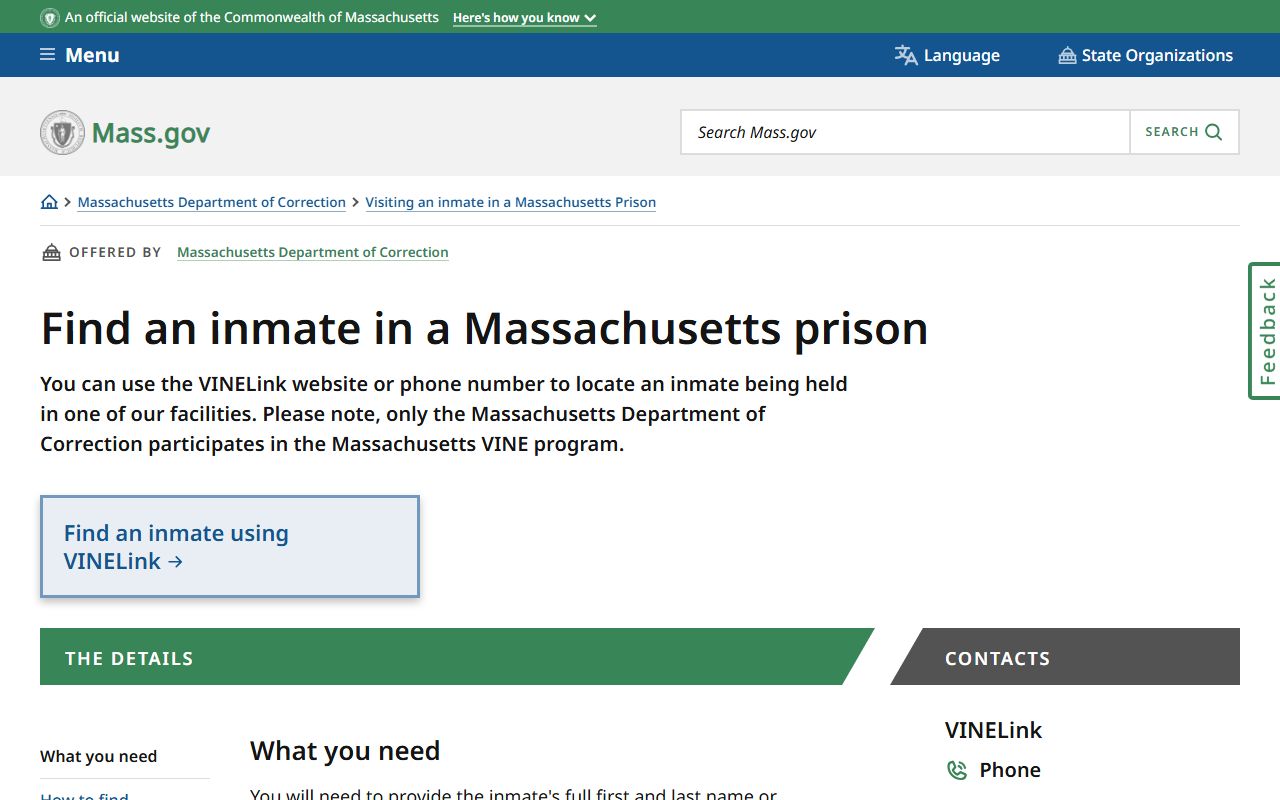
That page is the starting point for any notification or inmate-status search involving a Massachusetts DOC prisoner who may have ties to Middlesex County cases.
The fields you use when searching through the VINELink portal are listed in the table below.
| Field Label | Type | Required | Notes |
|---|---|---|---|
| State | Dropdown | Yes | Select Massachusetts. |
| Search Type | Tab / radio | Yes | Choose offender/person search or notification setup route. |
| Name | Text | Conditional | First and last name; required when searching by name rather than ID. |
| ID Number | Text | Optional | DOC or agency identifier if known; narrows results for common names. |
| Registration / Notification | Account / contact fields | Optional | Phone, email, or text fields for setting up release alerts. |
| Search | Button | Yes | Runs the search against DOC-participating facilities. |
The screenshot below shows the VINELink Massachusetts portal for custody notification and offender status.
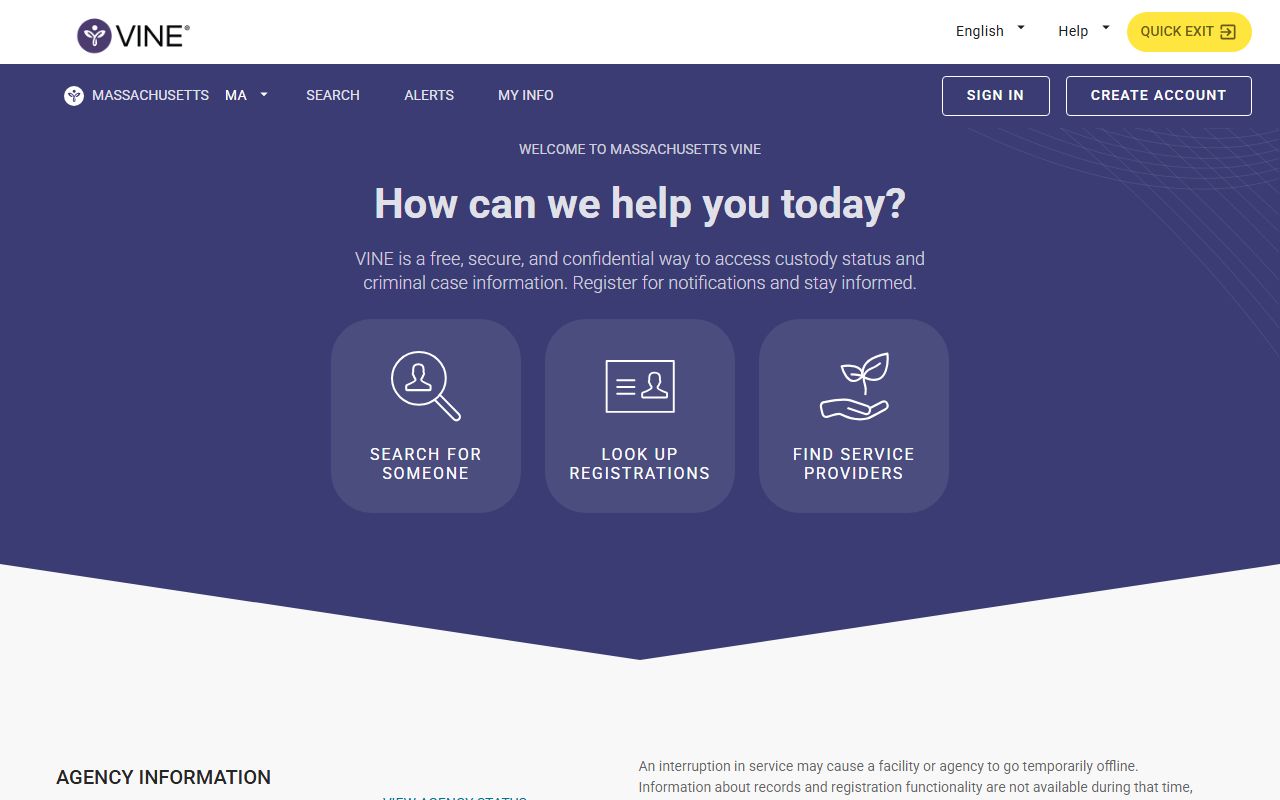
Registered users get a call, text, or email when the custody status changes, which is especially useful for victims and protected parties who need advance notice of a release.
Searching State and Federal Released Inmates
Massachusetts state prisoners and federal prisoners are two separate populations, searched through two different tools. Understanding which system held the person is the first step. County detainees at the Middlesex Jail are neither state DOC nor federal BOP prisoners, even if the underlying charge is a state or federal crime.
State prisoners who have been sentenced to a Massachusetts DOC facility are searchable through the VINELink route described above. Released DOC prisoners may appear in the locator with a "released" status. The VINELink search field table in the previous section covers those fields.
Federal inmates and released federal prisoners are tracked separately by the Federal Bureau of Prisons. People in federal custody may be held at a BOP facility anywhere in the country, at a contract facility, or, before sentencing, at a local lockup under U.S. Marshals hold. The BOP Inmate Locator at bop.gov/inmateloc/ is the official search tool for current and recently released federal prisoners. Middlesex County residents who face federal charges in the U.S. District Court for the District of Massachusetts may end up in BOP custody, which is why this tool matters for Middlesex-based searches.
The BOP locator returns results for both people currently in custody and those released since 1982. The fields used are listed below.
| Field Label | Type | Required | Notes |
|---|---|---|---|
| Find By Number | Tab | Optional | BOP Register Number, DCDC Number, FBI Number, or INS Number. |
| Find By Name | Tab | Optional | Switch to name-based search when no number is known. |
| First Name | Text | Optional | For name search; partial entry may work. |
| Last Name | Text | Required (name search) | Exact or partial name; exact spelling helps narrow results. |
| Race | Dropdown | Optional | BOP coded race options; helps narrow common names. |
| Sex | Dropdown | Optional | Male or Female. |
| Age | Number | Optional | Approximate age; narrows results for common names. |
| Search | Button | Yes | Runs BOP query and returns name, register number, age, race, sex, release date, and facility or "released." |
The BOP locator screenshot below shows the federal inmate search interface where released federal prisoners with Middlesex County connections can be found.
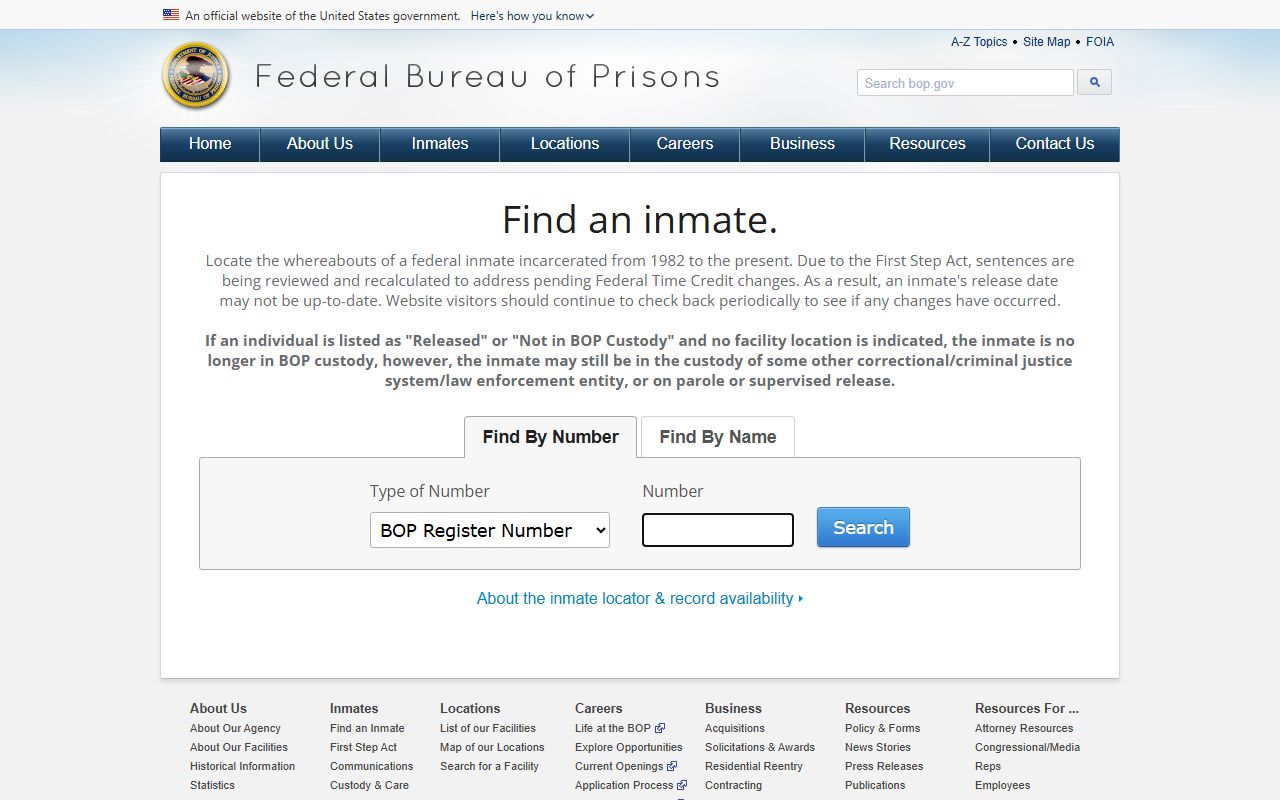
A typical BOP result for a released person shows name, register number, age, race, sex, and a release date. Current-custody results also show the facility name and location. Federal pretrial detainees may be housed at contract facilities not listed the same way as sentenced BOP prisoners, so a blank result does not always mean no federal hold exists.
Verifying Middlesex Release in Person or By Phone
Phone and in-person verification are still the most direct routes for Middlesex county jail releases. The jail operates under the Middlesex Sheriff's Office and the main number for custody and bail questions is 978-667-1711. After 4 p.m. and on weekends, callers press extension 0. Staff can confirm whether a named individual is currently in custody, though what they can say may depend on privacy rules, the type of case, and whether a protective order limits information sharing.
In-person verification is possible but less common for release checks. Bail posting happens at the Visiting Center, which accepts bail arrivals between 6:30 p.m. and 7:00 p.m. daily, cash only, with valid government-issued photo ID required. A family member who wants to confirm a release without posting bail should call first, since the visiting hours and release windows differ from the bail window.
For written confirmation, a public-records request to the Middlesex Sheriff's Records Access Officer is the formal path. The Sheriff's public records page explains how to submit a request and what to expect. Booking and release records are often releasable, but some information, including medical records, mental-health screening, security classification, victim information, and juvenile data, should be expected to be withheld or redacted.
The Middlesex County inmate records page covers the full process for checking current custody status, bail options, and jail contact information in more detail.
Massachusetts Sex Offender Registry After Release
When a person convicted of a sex offense is released from Middlesex County custody, state prison, or federal prison, registration obligations often begin immediately. Massachusetts uses a classification system administered by the Sex Offender Registry Board (SORB). The board classifies offenders as Level 1, Level 2, or Level 3 based on risk. Level 1 registrants are not publicly listed. Level 2 and Level 3 registrants are searchable through the public registry.
Two tools exist for searching sex offender registration status after release. The Massachusetts SORB has a request process described at mass.gov/how-to/request-sex-offender-registry-information. The national database, the National Sex Offender Public Website (NSOPW), is run by the U.S. Department of Justice and is available at nsopw.gov. NSOPW searches across all participating state and tribal registries at once, which is useful when a person may have registration obligations in more than one state.
The NSOPW search fields are shown in the table below.
| Field Label | Type | Required | Notes |
|---|---|---|---|
| Name | Text | Optional | First name, last name, or full name search. |
| Location | Text / address | Optional | Address, city, state, or ZIP with radius search option. |
| Jurisdiction | Dropdown / map | Optional | Search by state, territory, or tribe; select Massachusetts for state-specific results. |
| Captcha / confirmation | Security control | Yes (when prompted) | Prevents automated scraping; must be completed to run search. |
| Search | Button | Yes | Runs national public registry query across all participating jurisdictions. |
A typical NSOPW profile for a Massachusetts registrant shows name, aliases, photo if available, physical description, address or mapped area depending on classification, offense description, conviction or adjudication data, registration jurisdiction, and compliance or status notes. Registration requirements and what is publicly visible depend on the SORB classification. The statutory framework for Massachusetts sex offender registration is in M.G.L. c.6, § 178D (board duties) and M.G.L. c.6, § 178J (public access and classification).
Note: SORB classification and public listing can take time after release or conviction. A person who is newly released may not appear in the public database right away even if registration obligations have begun.
Parole and Probation After a Middlesex County Case
Two different supervision systems follow a Middlesex County criminal case after release: parole for people leaving state prison, and probation for people who received a probation sentence or condition from the trial court. These are not the same office and they are not the same process.
Parole is managed by the Massachusetts Parole Board for people released from Massachusetts DOC facilities. State-sentenced prisoners who have not served their full term may be released on parole with conditions. Violations can send a person back to prison. The Parole Board sets the conditions, and the supervising parole officer monitors compliance. Parole is not relevant for people who served their full sentence, for county jail detainees released on bail, or for people on probation through the court.
Probation is a court-based supervision sentence. In Middlesex County, probation departments sit inside each District Court and Superior Court division. A person on probation from a Middlesex Superior Court or District Court case reports to the probation department at that courthouse. The Probation Service is part of the Massachusetts Trial Court, not the Sheriff's Office. Conditions vary by case but can include reporting dates, no-contact orders, GPS monitoring, substance-use treatment, payment of fees, and stay-away provisions.
Massachusetts Parole Board
Statewide agency under the Executive Office of Public Safety and Security
Current contact details, regional office locations, and hearing schedules are posted on the official page.
For people on probation from a Middlesex trial court, the probation department phone is listed at each division's Mass.gov location page. For example, Lowell District Court probation is reached at (978) 459-4101, the same main line as the clerk. The Woburn District Court probation department shares (781) 935-4000. Released people must not miss a reporting date. Missing probation is a violation and can result in a probation warrant, which is a separate legal problem from the original charge.
Reentry Resources in Middlesex County
The Middlesex Sheriff's Office runs several reentry-focused programs inside the jail that carry forward to community supervision. People released from the Middlesex Jail and House of Correction may have worked with the Older Adult Re-Entry Unit, the Women's Pre-Release Center, the Housing Unit for Military Veterans, or programs called PACT and Project EARTH while in custody. Those units provide transition planning, housing placement help, and connections to community services before release. The Sheriff's programming page describes what is available inside the facility.
Outside the jail, community-based resources serve people who have been released from Middlesex County custody or any other facility. The categories below capture the main needs after release.
- Court obligations – next court date, probation reporting, GPS or no-contact order compliance, treatment attendance, and any fee or restitution payment schedule.
- Identification – state ID or driver's license, Social Security card, birth certificate, immigration documents where applicable. The RMV can be a first stop for ID replacement.
- Housing – shelter intake, transitional housing, sober housing, family reunification. Restraining orders or no-contact conditions may limit housing options.
- Health – MassHealth enrollment or reinstatement, prescription continuity, mental-health appointments, substance-use treatment continuation from any in-jail program.
- Employment – CORI-friendly job search, vocational training, work authorization documentation, transportation.
- Benefits – SNAP, cash assistance, disability benefits, veterans benefits if applicable.
- Legal cleanup – CORI sealing review, outstanding warrant check, RMV reinstatement, child support modification if incarceration affected payments.
Several legal aid and civil organizations serve people coming out of Middlesex County facilities. MassLegalHelp has plain-language guides on CORI, housing, and benefits. Greater Boston Legal Services offers civil legal aid for eligible Middlesex residents. MetroWest Legal Services covers the Framingham and MetroWest area. Community Legal Aid serves central and western Massachusetts communities that overlap with some Middlesex borders. Committee for Public Counsel Services provides appointed defense counsel and may still be involved if a criminal case remains open. The Massachusetts Court Service Centers, including the Lowell location, help with court navigation, forms, and process questions without acting as legal counsel.
See also the Middlesex County inmate population page for background on the facility, programming structure, and how the county jail fits into the broader Massachusetts correctional system.
Civil Rights Restoration After Release
Massachusetts law restores voting rights after release from felony incarceration. A person who was convicted of a felony and incarcerated cannot vote while serving that sentence. Once released, the right to vote is restored automatically. There is no waiting period and no petition required for voting restoration in Massachusetts. People held pretrial or serving misdemeanor sentences should not lose their right to vote at all, but anyone uncertain about current eligibility should verify with the Secretary of the Commonwealth's office, which handles voter registration guidance.
Beyond voting, other civil consequences of a criminal conviction in Massachusetts may include CORI restrictions, firearm prohibitions, professional licensing impacts, and immigration consequences for non-citizens. These do not lift automatically. CORI sealing, which limits public access to certain records after waiting periods, is a common step after release. The sealing process runs through the court or the Commissioner of Probation depending on the record type. Sealing and expungement are different, and neither is automatic. The main statutes are M.G.L. c.276, § 100A (conviction sealing after waiting periods) and M.G.L. c.276, § 100C (sealing after dismissal, acquittal, no bill, or no probable cause).
Firearms rights after a felony conviction are restricted under both state and federal law. Massachusetts has its own licensing framework through the Firearms Records Bureau and local licensing authorities. A person with a felony conviction should consult a lawyer before attempting to possess or apply for any firearm license. The rules are complex and violations carry serious criminal penalties.
Employment-related CORI rules changed with Massachusetts fair-chance hiring reforms. Employers with six or more employees are generally required to delay a criminal-history inquiry until after a conditional job offer under the CORI reform law. Guidance on employer CORI obligations is available from the Massachusetts Department of Criminal Justice Information Services, which administers the CORI system. For help navigating CORI sealing or the impact of a record on employment, the legal aid organizations listed in the reentry section above are the right starting point.