
What Probate Covers in Middlesex County
Probate in Massachusetts is broader than many people expect. It goes well beyond just handling a will after someone dies. Middlesex Probate and Family Court handles estate administration when a person passes away with or without a will, voluntary administration for small estates, formal and informal probate proceedings, guardianship of minors and adults, conservatorship over finances, trust matters filed with the court, and civil name-change petitions. The court also handles many family matters, including divorce and custody, which are covered on the marriage and divorce records page.
The governing statute is the Massachusetts Uniform Probate Code, codified at M.G.L. c.190B. That chapter brought Massachusetts into alignment with the Uniform Probate Code framework and created the current system of informal, formal, and supervised probate proceedings. Knowing which track applies to an estate is the first practical step before filing anything.
The Probate and Family Court department page gives a statewide overview of what the court handles and links to forms, standing orders, and the fee schedule.
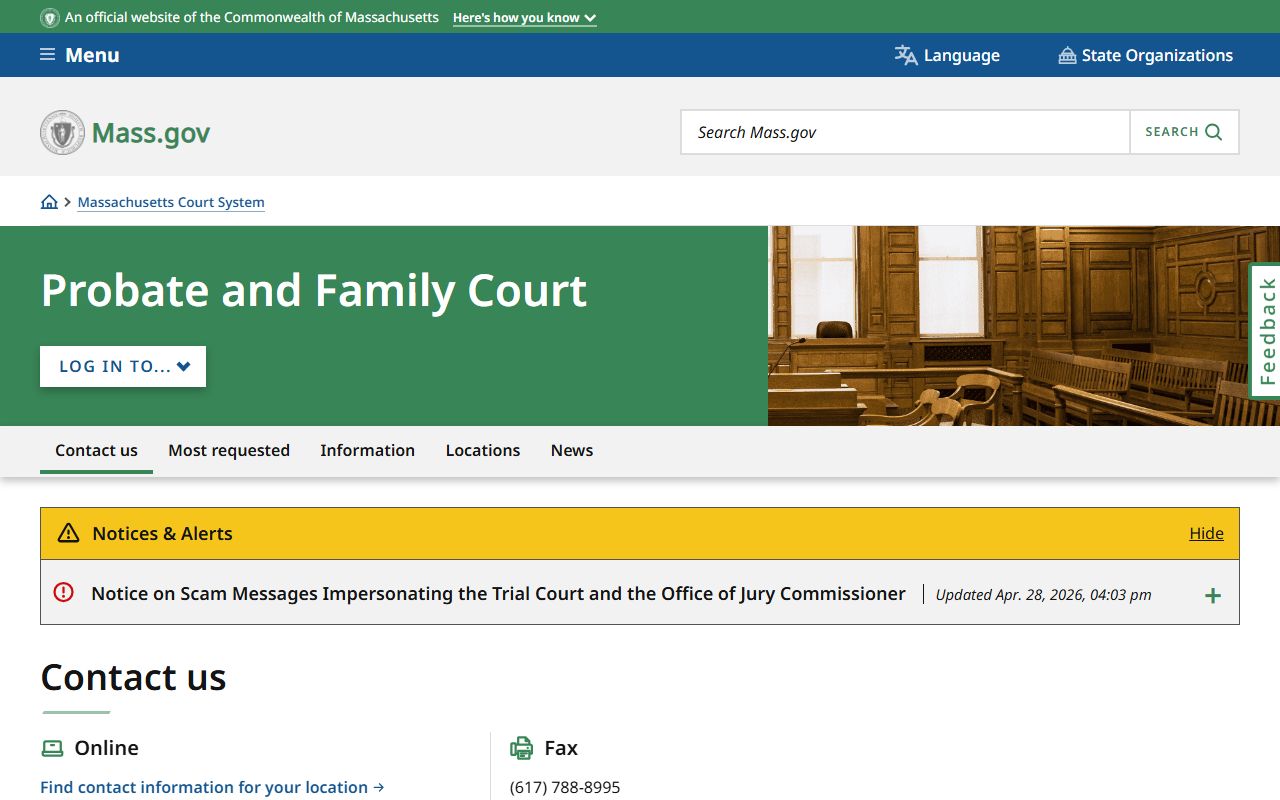
That department page is a useful starting point for understanding which forms apply and how each case type moves through the system before you ever drive to a courthouse.
Common Probate Terms in Middlesex Filings
Probate files use language that is specific to estate law. A few terms come up often, and getting them wrong can send a search in the wrong direction. The definitions below cover the ones you will see most in Middlesex Probate and Family Court dockets and documents.
- Testator
- The person who made a will. When a will is admitted to probate after death, the decedent is often called the testator in court filings and docket entries.
- Executor / Personal Representative
- The person named in a will, or appointed by the court, to carry out the estate administration. Under M.G.L. c.190B the term "personal representative" covers both executors named in a will and administrators appointed when there is no will.
- Intestate
- Dying without a valid will. An intestate estate follows the statutory succession rules in M.G.L. c.190B to determine who inherits and who can be appointed personal representative.
- Guardianship
- A court appointment that gives a guardian legal authority over the personal decisions of a minor or an incapacitated adult. Adult guardianship cases require medical or clinical evidence and ongoing court oversight.
- Conservatorship
- A court appointment focused on managing the financial affairs of a person who cannot do so themselves. A conservator may need to file an inventory, post a bond, and submit accounts to the court on a regular schedule.
Note: "Letters of authority" is the document the court issues to a personal representative, guardian, or conservator. Banks and registries of deeds commonly ask for a certified copy of letters before they act on behalf of an estate or protected person.
Middlesex Probate and Family Court Locations
The court has two sitting locations in Middlesex County. Most people filing in the northern part of the county use the Lowell location. Those in the southern part of the county, closer to Woburn, use the South Woburn location. If you are not sure which location handled a specific case, start with the online docket search and look at the division field in the case detail. You can also call either location and ask which office holds the file.
Middlesex Probate and Family Court – Lowell
Middlesex Probate and Family Court – South Woburn
Street addresses, phone numbers, and hours for both locations are listed on the Mass.gov location pages linked above. Addresses on Mass.gov are kept current by the Trial Court, so they are a more reliable source than any third-party listing. For copy requests or archive retrieval, confirm which location holds the file before you visit, because a trip to the wrong building wastes time.
The South Woburn location is also shown on the official Middlesex Probate and Family Court location page. The South Woburn court location page on Mass.gov lists current contact details, ADA access information, and parking guidance.
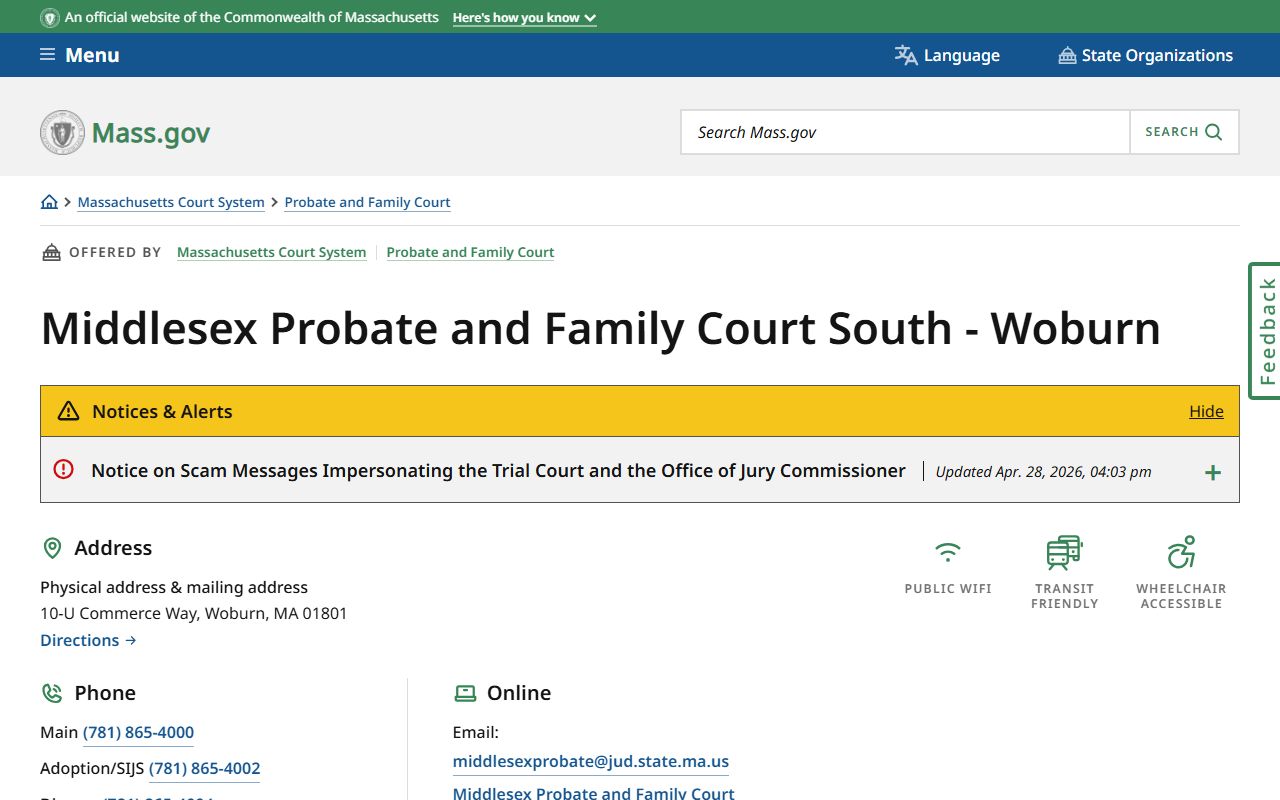
Confirming the address on that page before you drive is a good habit, because court building assignments can shift and signage at the South Woburn complex may not match what you expect.
How Probate Works in Middlesex
The probate process in Middlesex follows the M.G.L. c.190B framework. Whether a case goes through informal, formal, or supervised probate depends on whether the estate is contested, whether a will needs to be proven, and whether the heirs agree. Most uncontested estates with a clear will go through informal probate, which is faster. Formal probate is needed when someone contests the will, heirs cannot agree, the court needs to rule on who can serve as personal representative, or other disputes arise. The steps below apply to most estate filings.
- Determine whether the estate qualifies for voluntary administration, informal probate, or formal probate based on the size of the estate, the nature of the assets, and whether a will exists.
- File the correct petition in Middlesex Probate and Family Court at the location where venue is proper. Bring the original will if there is one, along with the death certificate.
- Submit the required bond, assents, waivers, and the filing fee or an approved fee-waiver affidavit. The fee schedule is set by the Trial Court, not by the county.
- Provide statutory notice to heirs and interested parties. Some cases require publication in a newspaper if not all parties can be personally served.
- Receive the decree, appointment, and letters of authority from the court once the petition is approved.
- Inventory estate assets, pay claims and taxes in the correct priority order, and manage the property during administration.
- File an account with the court if required, distribute the remaining property to the correct beneficiaries or heirs at law, and close the estate with a final decree.
Guardianship and conservatorship matters follow a parallel path but require clinical or medical evidence and ongoing reporting. Those proceedings do not close the way an estate does. The court retains oversight for as long as the appointment is in effect.
Middlesex Probate Record Types and Public Access
Not every document in a probate file is open to the public. The docket itself is generally public, but individual documents within a case may be restricted, redacted, or impounded depending on the case type, the nature of the information, or a specific court order. The table below covers the main case types and notes the general public-access status of the records in each.
| Case Type | Typical Public Records | Common Restrictions |
|---|---|---|
| Informal probate | Petition, docket entries, appointment, and most filings | Personal identifiers and restricted documents redacted or withheld |
| Formal probate | Citations, returns of service, appearances, objections, decrees, motions, hearing records | Same redaction rules; contested matters may have impounded exhibits |
| Voluntary administration | Petition and docket; file is usually short | Subject to same personal-identifier rules |
| Adult guardianship | Petition, citation, decree, care plan, annual reports at the docket level | Medical certificates and clinical team reports may not be public; health details are sensitive |
| Conservatorship | Petition, bond, appointment, inventory, general account information at the docket level | Detailed financial schedules and account data may be redacted |
| Name change | Generally public unless impounded for safety or other legal reason | Court may impound if public disclosure poses a safety risk |
| Trust matters | Petitions to interpret, modify, terminate, or account for trusts at the docket level | Trust instruments or financial schedules may be restricted by order or rule |
| Adoption | None as a general matter | Confidential under M.G.L. c.210, § 5C; access only through the statutory process |
Adoption records deserve a specific note. They are confidential and do not appear in a standard public probate docket search. Access to sealed adoption records requires following the process under M.G.L. c.210, § 5C, which is a separate statutory route and not a standard public-records request.
How to Search Middlesex County Probate Records
Public docket data for Middlesex Probate and Family Court cases is available through MassCourts eAccess, the Trial Court's free case search portal. The docket search shows case numbers, party names, case types, filing dates, event logs, and docket entries. Full document images may not be available for all cases, and older files may require an in-person or written request to the Register's Office. The search steps below work for most current estate, guardianship, and conservatorship cases.
- Go to MassCourts eAccess and choose the Probate and Family Court department.
- Select the Middlesex division from the location dropdown. The portal lists both the Lowell and South Woburn divisions; if you are not sure which one holds the case, try both.
- Enter the decedent's name for an estate case, or the name of the person subject to guardianship or conservatorship. For name-change cases, use the petitioner's name at the time of filing.
- Add a filing-year range if you have one. This cuts down results when the name is common.
- Review each result row for the docket number, case type, and status. Open the case detail to see the event log and any docket entries available online.
- If you need certified copies, a specific document, or a file older than what the portal shows, contact the Register's Office at the correct location. For old or archived files, ask about retrieval time before you plan a visit.
Common documents in a probate file include the petition for probate, death certificate, original will, assent and waiver forms, citation, bond, decree and order, letters of authority, inventory, account, notice to creditors, and in guardianship or conservatorship cases, a guardian or conservator medical certificate and any Rogers or medical treatment plan where applicable.
Middlesex Probate Filing Fields
When a petition is filed with Middlesex Probate and Family Court, it must include certain information that becomes part of the official court record. The table below shows the main fields collected across estate, guardianship, and conservatorship filings. Some fields are conditional, meaning they apply only to specific case types.
| Field Label | Type | Required | Notes |
|---|---|---|---|
| Decedent / Protected Person Name | Text | Yes | Subject of the estate, guardianship, or conservatorship proceeding. |
| Date of death / date of birth | Date | Conditional | Death date for estate cases; date of birth for guardianship or conservatorship matters, and may be restricted. |
| Case Type | Dropdown | Yes | Informal probate, formal probate, voluntary administration, guardianship, conservatorship, trust, or name change. |
| Petitioner name / address | Text | Yes | The person seeking the appointment or court order. |
| Interested persons / heirs | Text / list | Yes | Required so the court can direct statutory notice to each party. |
| Will filed? | Checkbox | Conditional | The original will is normally required if petitioning to probate a will. |
| Filing fee | Payment | Yes, unless waived | Set by the current Trial Court fee schedule; fee waivers are available through the affidavit of indigency process. |
| Bond / accounting | Checkbox / form | Conditional | A bond may be required depending on appointment type; ongoing accounts are required for conservatorships and some guardianships. |
The statute at M.G.L. c.190B sets out the specific content requirements for each petition type. Looking up the relevant article within that chapter before you file tells you exactly what is needed for your case type.
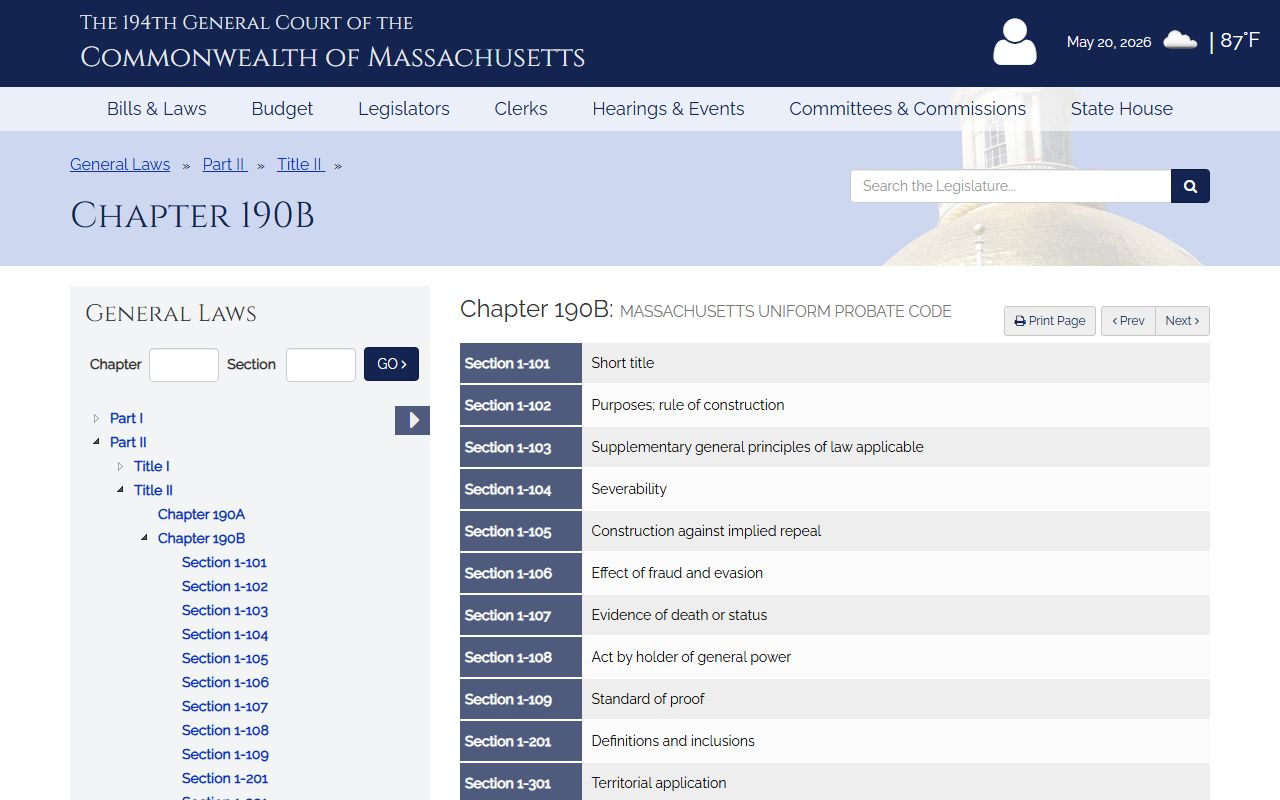
The full text of M.G.L. c.190B is on the Massachusetts legislature site and is the authoritative source for what each type of petition must contain and how proceedings are conducted.
Probate Filing Fees in Middlesex County
Massachusetts does not set a flat county probate fee. Fees for Middlesex Probate and Family Court filings are governed by the statewide Trial Court fee schedule, not by a local county rule. The amount you pay depends on the type of petition, the type of copy you request, and sometimes the size of the estate. Because the schedule can change, always confirm the current amount with the Register's Office before you file or request copies.
| Item | How the Fee Is Set |
|---|---|
| Petition for informal or formal probate | Set by the Trial Court fee schedule; estate-based filing fees may vary by asset value under the schedule. |
| Voluntary administration | Lower filing fee for qualifying small estates; check the current schedule. |
| Guardianship or conservatorship petition | Set by the Trial Court fee schedule for each appointment type. |
| Name-change petition | Separate fee set by the schedule for civil name-change filings. |
| Plain copy (per page) | Per-page rate from the Trial Court schedule; needed for personal review. |
| Certified / attested copy | Higher rate than a plain copy; banks, registries of deeds, and government agencies typically require this level. |
| Archived file retrieval | For older files that are not on the active shelf, the Register's Office may need archive retrieval time; ask before you visit. |
| Fee waiver (affidavit of indigency) | Available through the court; the affidavit process is the standard route when a party cannot afford fees. |
If you need a certified copy for a bank, a registry of deeds, or an out-of-state agency, ask specifically for an attested or certified copy. A plain docket printout is not accepted for most formal legal or financial purposes.
Guardianship and Conservatorship Records
Guardianship and conservatorship cases are among the more complex Middlesex probate matters because they involve ongoing court supervision. Unlike an estate, which closes when assets are distributed, a guardianship or conservatorship remains active as long as the appointment stands. The court monitors these cases through required reports, medical or clinical updates, and periodic accounts.
Adult guardianship filings require clinical or medical evidence supporting the finding of incapacity. The petition, citation, and decree may be public at the docket level, but the medical certificate and any clinical team report contain health information that the court treats as sensitive. Access to those documents is not the same as access to the general docket. A conservator, who manages financial affairs, must typically post a bond and file periodic accounts. The inventory and bond are usually part of the public file, but detailed financial schedules in the accounts may be redacted to protect the protected person's private financial information.
For family members trying to understand an existing guardianship or conservatorship, the docket search on MassCourts shows the case history, event dates, and basic filing information. For the underlying documents, a request to the Register's Office at the correct Middlesex location is usually the next step.
Adoption Confidentiality
Adoption records held by Middlesex Probate and Family Court are confidential under M.G.L. c.210, § 5C. They are not part of the public probate file and do not appear in a standard docket search. Access to sealed adoption records requires following the specific statutory process, which is separate from a regular public-records or court-copy request. Treating adoption records as ordinary public probate records would be incorrect.
If you have a question about accessing adoption records, the correct starting point is the statute itself and any standing orders the Probate and Family Court has issued on the topic. Legal aid or a private attorney with adoption experience can help you understand what the process involves and whether you qualify for access.
Tips for Getting Middlesex Probate Copies
Getting the right copy from Middlesex Probate and Family Court is easier when you know what to ask for. The most common mistake is paying for a plain docket printout when a bank or government office actually needs a certified or attested copy. Ask about the correct copy type before you request it, especially if the document will be used for real estate, banking, immigration, or out-of-state legal proceedings.
- A will is only a public probate file after it has been filed in connection with an estate proceeding. A living person's will is not a public record just because they live in Middlesex.
- After death, the original will may be filed with Middlesex Probate and Family Court as part of an estate case. Once filed, the will is generally part of the public case file.
- A certified copy of letters of authority is often more useful than a plain docket sheet when dealing with banks, registries of deeds, or out-of-state agencies. Ask the Register's Office for attested or certified letters, not just a printout.
- For older estate files, archive retrieval may add time. Call ahead to ask how long retrieval takes before you plan a trip to either Middlesex location.
- If the estate involved real estate in Middlesex, also check the appropriate Middlesex Registry of Deeds. Deeds, releases, and fiduciary certificates may be recorded there even though the underlying estate case is at Probate and Family Court.
Important: A certified copy of a probate decree or letters of authority is not the same as a plain court printout. Financial institutions and registries of deeds almost always require the certified version. Confirm the required document type before ordering.