
Massachusetts Public Records Law
The Massachusetts Public Records Law is the state's main open-records statute. It applies to executive agencies and local government bodies, including municipal police departments, the Middlesex Sheriff's Office, the Middlesex District Attorney's administrative records, city and town clerks, the Registry of Motor Vehicles, and state executive agencies. The law gives any person the right to request records from a covered agency. You do not have to explain why you want the records or show that you are a Massachusetts resident.
The definition of "public record" in M.G.L. c.4, § 7(26) is broad. It covers documents, data, photographs, recordings, and other materials made or received by a public agency in the course of official business. The definition is wide by design, and the burden of showing a record is exempt falls on the agency, not the requester. That said, the same statute lists exemptions that can limit or block access. Privacy, investigatory, personnel, medical, security, trade-secret, and public-safety exemptions all appear in the list. An agency may release a record with parts redacted instead of withholding the whole thing.
The Massachusetts Secretary of State maintains a public-records guide and provides oversight of the law's administration. The office's resources and the Supervisor of Records staff can help requesters who run into problems with agency responses.
The request procedure under M.G.L. c.66, § 10 is the procedural backbone. Agencies must respond within statutory timeframes and may provide records in electronic form. Massachusetts law actually encourages electronic production when the agency can do so without unreasonable cost. If fees apply, the agency must give an estimate before charging. The state law sets limits on what agencies can charge for search, segregation, and copying work. Understanding that framework prevents sticker-shock when a request comes back with a fee estimate.
The statute authorizing public records requests in Massachusetts is worth reviewing directly. The Mass. Legislature page for M.G.L. c.66, § 10 shows the request procedure, response-time rules, electronic-production language, and fee provisions as enacted.
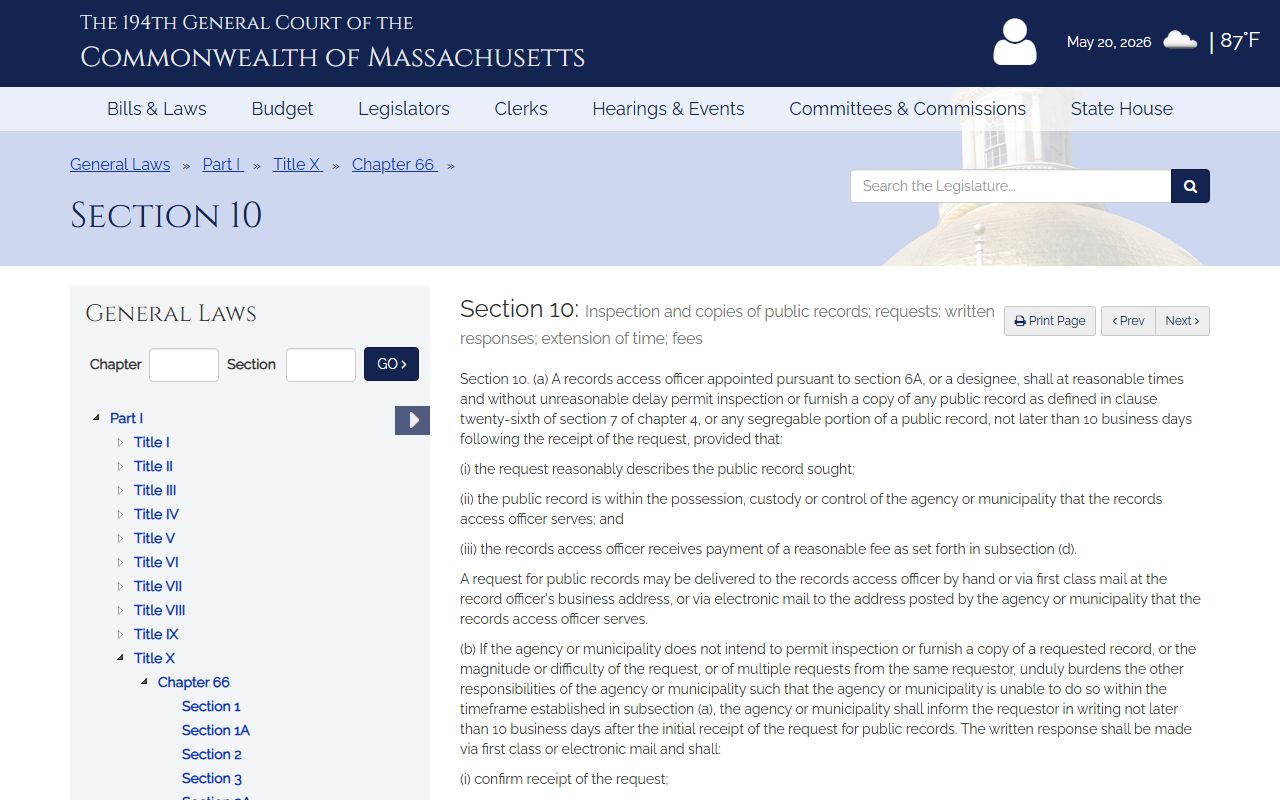
That statutory text is the starting point for any Middlesex County public records request sent to the Sheriff, the DA, a city clerk, or another covered agency.
The Layered Access Framework for Middlesex Records
Important: Court case files in Middlesex County are NOT ordinary public-records-law records. They are governed by Massachusetts Trial Court public-access rules and common-law court access principles, not by the Public Records Law. Sending a public-records request to a court clerk for a case file will not work. Use the Trial Court's access procedures and the MassCourts public portal instead.
Massachusetts public access splits into three layers, and mixing them up leads to wrong requests sent to the wrong offices. The layers are distinct, and each has its own procedures.
Layer one is ordinary government records. The Sheriff's Office, the Middlesex DA, police departments, city clerks, town clerks, the RMV, and most state executive agencies fall under the Public Records Law. A written request to the agency's Records Access Officer (RAO) starts the process. If the agency denies the request or does not respond in time, the requester can appeal to the Supervisor of Records under M.G.L. c.66, § 10A.
Layer two is court case records. Case files held by the Judicial Branch are governed by the Massachusetts Trial Court Rules on Public Access to Court Records, common-law access principles, impoundment orders, and department procedures. A docket may be public while a document in that docket is impounded. A document may be available at the courthouse but not online. A party may see more than a nonparty. An attorney with e-filing access may see things the general public cannot. These distinctions explain why a person may find a case caption online but need to call or visit the clerk for a certified copy of the actual disposition.
Layer three is criminal-history reporting through CORI. The CORI statutes, mainly M.G.L. c.6, § 167A (definitions) and M.G.L. c.6, § 172 (dissemination), control what criminal offender information flows through the Department of Criminal Justice Information Services to employers, housing providers, licensing boards, courts, and other authorized users. A public court docket can show that a criminal case existed, but a full statewide background check is a CORI matter governed by those separate rules. Do not expect MassCourts to replace an official CORI report.
Public Records Definition and Exemptions
The definition of "public record" in Massachusetts law is intentionally broad, but the exemptions carved out of it are substantial. Knowing what each exemption covers helps a requester predict which parts of a record an agency might redact or withhold, and whether an agency's denial has a legal basis or is worth challenging.
The full statutory definition and its exemptions appear at M.G.L. c.4, § 7(26). The page at the Mass. Legislature website displays the statute as it currently reads, including all the exemption clauses.
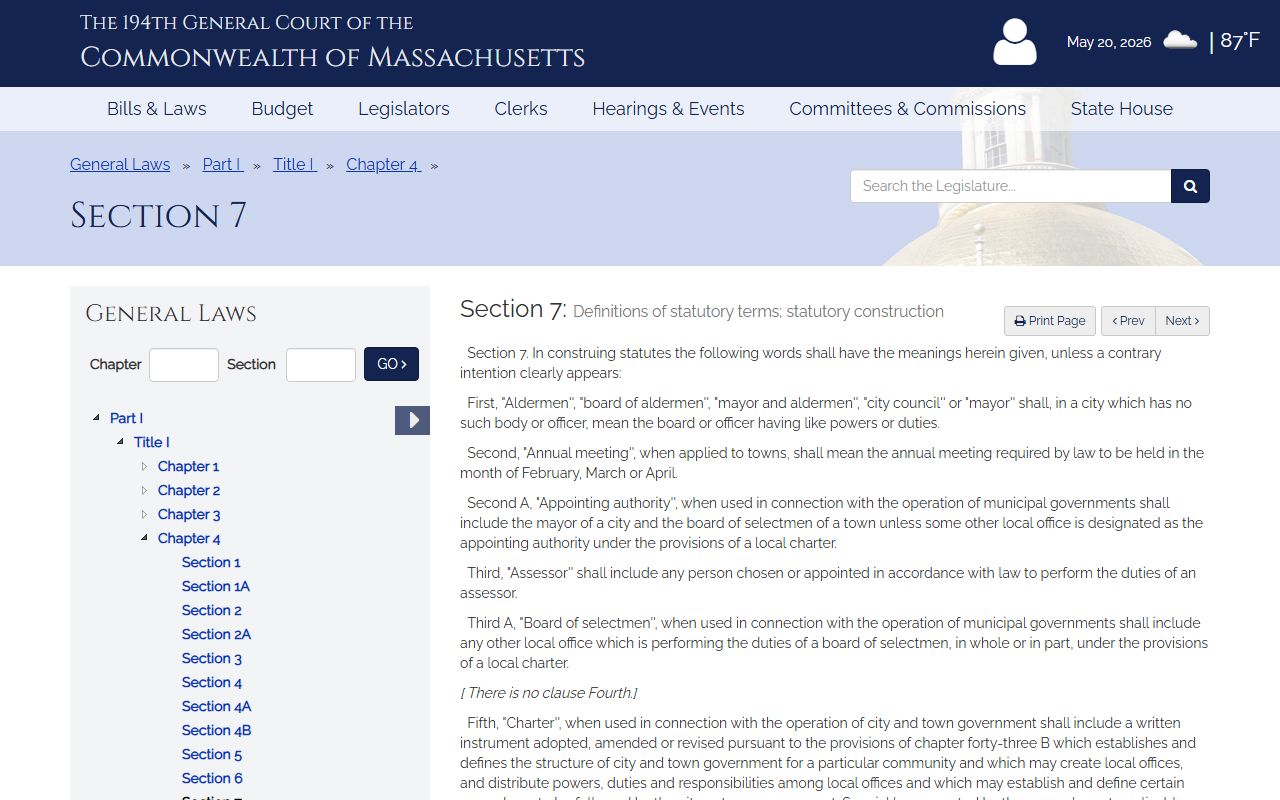
That statutory text is worth reading before you file a Middlesex County public records request, because it tells you what the agency can lawfully withhold and what it cannot.
The most common exemptions agencies invoke for Middlesex records are these:
- Privacy exemption – protects intimate personal details, such as medical, financial, and home-address information in many contexts.
- Investigatory exemption – can shield law-enforcement materials where disclosure would prejudice effective law enforcement or reveal investigative techniques.
- Personnel exemption – covers employment evaluations, discipline records, and personnel files of government employees.
- Medical exemption – protects health-related information, which matters in jail and corrections records.
- Security exemption – can protect facility layouts, emergency plans, cybersecurity procedures, and similar public-safety information.
- Trade-secret / proprietary exemption – may apply to vendor contracts or business filings that include protected commercial information.
When a Middlesex agency cites one of these exemptions, it must identify which one applies. It cannot just say "exempt" without pointing to the law. A vague denial is itself grounds for an appeal to the Supervisor of Records.
Middlesex Sheriff Public Records
The Middlesex Sheriff's Office operates the county jail and house of correction in Billerica. Its administrative records, policies, contracts, and many operational records fall under the Public Records Law. The Sheriff's office identifies a Records Access Officer for handling incoming requests. Jail booking and release records, policies, incident summaries, and staffing data may be available through a public-records request, though medical screening notes, classification materials, security-housing details, PREA (Prison Rape Elimination Act) files, and protected health information can be withheld or redacted.
The Sheriff's public-records page at middlesexsheriff.org/238/Public-Records is the correct starting point for requests about jail administration, policies, or other Sheriff administrative matters. This is not the route for court case files or court-ordered records.
For custody questions about a specific person, calling the jail directly or checking the Middlesex County court records docket may be faster than a public-records request. The court docket often shows bail status, arraignment, and warrant information that reflects custody in real time.
Note: A booking record may be available through the Sheriff, but the court case file showing the charges, bail, and arraignment outcome lives in the District Court or Superior Court clerk's office, not the jail.
Middlesex DA and Municipal Public Records
The Middlesex District Attorney's administrative records are also subject to the Public Records Law. That covers contracts, budgets, personnel data (with standard exemptions), policy documents, and certain administrative communications. Active case files, grand-jury materials, and investigative records are generally exempt from public disclosure because releasing them could prejudice law enforcement and because grand-jury secrecy is a separate legal principle. Do not expect to get a prosecutor's case file through a public-records request while a case is pending.
City and town police departments in Middlesex County are public bodies under the law. Incident reports, call logs, and public-facing records can often be requested through the police department's RAO. Investigatory exemptions may apply to portions of incident reports that contain witness identities, ongoing investigation detail, or victim information. Most Middlesex police departments accept records requests by email or written letter addressed to the department's RAO.
For criminal court records, the case file lives at the courthouse, not the DA's office. The Middlesex County arrest records page covers the court-side of that picture, and for jail information see the inmate records page.
How to File a Middlesex County Public Records Request
Filing a public-records request in Middlesex County follows the statewide procedure set out in M.G.L. c.66, § 10. The core steps are straightforward. The harder part is identifying the right agency before you write the letter. Sending a request to the wrong office wastes time, because that office has no duty to transfer your request to the agency that actually holds the records.
- Identify the correct agency. Match the record type to the custodian. Sheriff administrative records go to the Middlesex Sheriff's Records Access Officer. City police reports go to the local police RAO. City clerk records go to the city or town clerk. For court files, skip the public-records route entirely and use the Trial Court's access procedures or the MassCourts public portal.
- Write a clear description of the records you want. Say what type of record, what date range, what person or incident if relevant, and what format you prefer. You do not need a legal citation in your request. Plain language is fine. Massachusetts law does not require you to explain your purpose.
- Address the request to the Records Access Officer. Every public body must designate an RAO. Large agencies like the Sheriff and DA post RAO contact information on their websites. Smaller departments may list it on the agency's contact page or you may need to ask.
- Submit by email, mail, or any channel the agency accepts. Email is common and creates a written record with a timestamp. Massachusetts law encourages electronic production, so asking for records in electronic format is reasonable and may reduce fees.
- Wait for the agency's response. Under M.G.L. c.66, § 10, the agency has a statutory number of business days to respond. A response means either producing the records, giving a fee estimate, asking for clarification, or explaining why a record is exempt. If the agency does not respond at all, that is itself a basis for appeal.
- Review the fee estimate and pay if you agree. The agency produces the records after you agree to pay or after production if there is no fee. Massachusetts law limits what agencies can charge. Electronic copies typically cost less than paper copies, and there are caps on search and segregation time fees in many cases.
- Appeal if denied or if the response is inadequate. If the agency denies your request or produces an incomplete response without a valid reason, you can appeal to the Supervisor of Records under M.G.L. c.66, § 10A. That administrative route is free and does not require a lawyer.
Public Records Request Form Fields
No single statewide form is required under Massachusetts law. Most agencies accept a letter or an email. However, some agencies post a preferred form or template on their website. The Middlesex Sheriff's public-records page describes the RAO process. Regardless of format, a well-organized request includes the following fields. The table below shows the fields used for Sheriff public-records requests, drawn directly from the office's RAO process, and the same core information applies to requests sent to other Middlesex agencies.
| Field | Required | Notes |
|---|---|---|
| Requester name | Yes / unspecified | Massachusetts law does not always require identity, but contact information is needed so the agency can send its response and any fee estimate. |
| Contact email, phone, or mailing address | Yes for delivery | Provide at least one reliable way for the agency to reach you. Email is common and creates a time-stamped record. |
| Description of records sought | Yes | Describe the record by type, date range, person, incident, policy, report, or file category. The more specific you are, the faster the agency can locate the records and the lower the search cost. |
| Preferred format | Optional | State that you prefer electronic copies if available. Massachusetts law encourages electronic production when the agency can do it without unreasonable cost, and electronic copies are often cheaper. |
| Fee agreement / cap | Conditional | You may tell the agency you agree to pay fees up to a stated amount and would like a cost estimate before production if fees exceed that amount. This prevents surprise charges. |
For requests to the Middlesex Sheriff, direct your letter or email to the Records Access Officer at the Sheriff's Office. The RAO page at middlesexsheriff.org/238/Public-Records confirms the contact process. For other Middlesex agencies, check the agency's website for its RAO name and contact.
Trial Court Public Access Rules for Middlesex Cases
Court case files in Middlesex County are governed by the Massachusetts Trial Court Rules on Public Access to Court Records, not by the Public Records Law. These rules cover all Trial Court departments, including Superior Court, District Court, Probate and Family Court, and Housing Court. The rules set out what is open to the public, what is impounded, what is available only at the courthouse, and what categories are entirely excluded from public access.
The key distinction for Middlesex users is this: a docket may be visible online while the underlying documents are not available remotely. A person may see the case caption, the event log, and the disposition entry in MassCourts without being able to download the complaint, motion, or medical exhibit. A party has broader access than a nonparty. An attorney with an e-filing account may see more than a member of the public at the same terminal. These layers reflect a design choice by the Trial Court to balance openness with privacy, safety, and statutory confidentiality.
When a case is impounded, the impoundment order itself may or may not be visible. Impoundment is not the same as sealing. An impoundment order restricts access to some or all of the case file under a specific court order, often to protect victim addresses, trade secrets, juvenile identities, or sensitive medical information. A sealed record under M.G.L. c.276 is a different proceeding, governed by criminal sealing statutes. You cannot appeal an impoundment order to the Supervisor of Records. You would need to file a motion in the court that entered the order.
The full rules are posted on Mass.gov. The Trial Court public-access rules page is the authoritative source for understanding what the court can withhold, what must be open, and how to request access that the public portal does not provide.
Practical examples from Middlesex courts: a Lowell District Court criminal docket may show arraignment, bail, pretrial conference, motion, disposition, and warrant recall entries, but police reports, victim information, medical records, and probation internal notes may not be publicly downloadable. A Probate and Family Court estate docket and decree may be open, while a guardianship medical certificate or financial account number is restricted. A divorce judgment may be obtainable, while financial statements, child records, and any impounded addresses may not be public.
Response Timelines and Electronic Records
Under M.G.L. c.66, § 10, a Middlesex public agency must respond to a public-records request within the timeframe set by statute. The agency's response does not have to produce all the records immediately. A lawful response can include producing the records, sending a fee estimate, asking for clarification about an unclear request, or explaining which exemption applies to a withheld record. An agency that says nothing within the statutory window has effectively denied the request by inaction, which opens the appeal path.
Massachusetts law is explicit that agencies should provide electronic records when they can. If you request an electronic copy and the agency can produce one without unreasonable cost, it should do so. This matters for Middlesex requesters because electronic production is often faster than waiting for physical copies and can reduce per-page fees. When you file your request, stating your preferred format as electronic signals to the RAO that electronic production is acceptable.
If your request is for a large volume of records or involves extensive search and segregation work, the agency may give you a fee estimate before producing anything. You can then decide whether to agree to the estimate, narrow your request to reduce cost, or withdraw. The agency cannot produce records and then bill you without your agreement first.
Middlesex Public Records Fees and Court Copy Fees
Public Records Law fees and court copy fees are different, and it matters which framework applies to your request. If you are requesting records from the Sheriff, the DA, a city police department, or another Public Records Law agency, the fee rules come from M.G.L. c.66 and the Massachusetts Secretary of State's guidance. If you are requesting court file copies from a clerk's office, the fee rules come from the Trial Court fee schedule, which is grounded in M.G.L. c.262, § 4C, standing orders, and departmental schedules.
The table below shows how fees differ depending on where the records come from and what type of copy you need. Specific dollar amounts are set by statute and schedule and can change. Always confirm the current charge with the specific office before you pay.
| Record Type and Source | How the Fee Is Set |
|---|---|
| Public Records Law copy (Sheriff, DA, city agency) | Per-page copy rate and search/segregation time rates set by state law and the Secretary of State's guidance; Massachusetts encourages low-cost or free electronic production. |
| Plain court file copy (clerk's office) | Per-page rate under the Trial Court fee schedule; varies by department. |
| Certified or attested court copy | Higher rate than plain copies; required for official legal use such as immigration, licensing, or out-of-state court filings. |
| Docket sheet printout | Per-page or per-document; set by department. |
| Audio recording copy | Separate schedule from paper copies; ask the clerk for the current rate. |
| Archived file retrieval | May add retrieval time and a separate charge for older files pulled from off-site storage. |
| Fee waiver (court filings) | Available through the Massachusetts affidavit of indigency process for people who cannot afford court costs. |
Do not assume a flat fee applies to all Middlesex records. A certified copy of a Middlesex Superior Court judgment costs differently than a plain copy of a District Court docket sheet, which costs differently than a public-records-law electronic file from the Sheriff's Office. Ask before you pay, and get the estimate in writing when possible.
Middlesex Public Records Appeals to the Supervisor of Records
If a Middlesex public agency denies your public-records request, provides an inadequate response, or fails to respond at all within the statutory timeframe, you can appeal to the Supervisor of Records. The Supervisor sits within the Massachusetts Secretary of State's office and has authority to review agency decisions under the Public Records Law. The appeal process is administrative, free, and does not require legal representation, though you may hire a lawyer if you choose.
The appeal statute is M.G.L. c.66, § 10A. The Mass. Legislature page for that section shows the process, the grounds for appeal, and the Supervisor's authority.
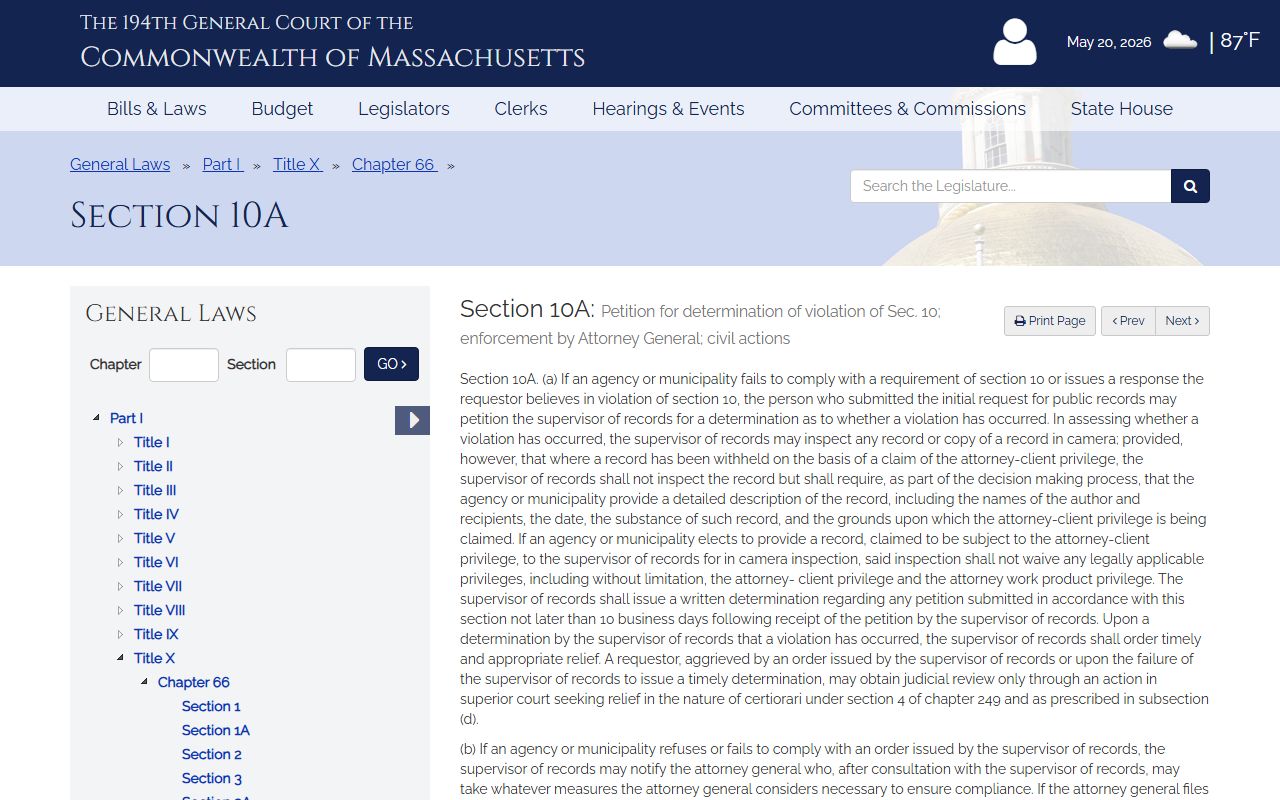
The Supervisor of Records can order the agency to produce the records, require a particularized explanation of the exemption claimed, or uphold the denial if the exemption is valid.
This appeal route is for Public Records Law agencies: the Sheriff, the DA, police departments, city and town clerks, and other government bodies. It is not the path for challenging a court clerk's application of Trial Court access rules, an impoundment order, or a sealing ruling. Those disputes belong in the court that issued the order, through a motion to modify or a direct appeal of the ruling under court procedure. The distinction matters because going to the Supervisor about a court-file issue is a dead end.
If an appeal to the Supervisor does not resolve the issue, a requester can seek review in Superior Court. That step requires filing a complaint and involves litigation costs, so it is most common for high-value or high-volume records disputes where the agency is clearly wrong and the records are important.
Restricted Records and Exempt Categories
Some Middlesex records are restricted no matter which law applies. Knowing which categories are off-limits prevents wasted requests and helps you plan around the restriction if another path exists.
Under the Public Records Law's exemptions in M.G.L. c.4, § 7(26), agencies may withhold personal medical and mental-health information, active investigatory materials, and security-sensitive operational details. Under Trial Court access rules, entire categories of court records are excluded from public access and from remote access. These include juvenile court records, adoption files, impounded case materials, grand-jury transcripts and materials, sealed search warrants, and protective-order contents with victim addresses or safety information. Under CORI statutes, the public's access to statewide criminal history is limited; not everyone can see everything a criminal-justice agency can see.
Specific restricted categories in Middlesex courts include the following:
- Juvenile delinquency records (Middlesex Juvenile Court, governed by M.G.L. c.119 and Juvenile Court rules)
- Adoption records (confidential under M.G.L. c.210, § 5C except through statutory process)
- Sealed criminal records (restricted under M.G.L. c.276, § 100A and § 100C)
- Expunged records (removed or destroyed under narrower statutory criteria)
- Mental-health, medical, and guardianship medical certificate materials
- Financial statements in divorce and family cases
- Victim addresses, affidavits, and safety information in abuse-prevention cases
- Grand-jury materials and unreturned search warrants
- Minors' names and child welfare records
- Social Security numbers and financial account numbers
Sealing limits public access but does not destroy the record. Expungement can result in actual deletion under stricter eligibility rules. A dismissed case is not always invisible right away. A person seeking to seal their own Middlesex criminal record should use official court forms and should consider getting legal help, because the rules about waiting periods, eligible offenses, and correct courts are technical. See the Middlesex County arrest records page for more on sealing and expungement procedures.
Help with Middlesex County Public Records Requests
Getting legal or practical help with a records request is worth considering when an agency denies your request, when the records are for a legal proceeding, or when you are not sure which office holds what you need. Several resources serve Middlesex County residents who need help navigating the public-records or court-access system.
Community Legal Aid serves central and western Massachusetts communities, including parts of western Middlesex County, depending on issue type and eligibility. Its website offers guides on how to access records and on related legal rights.
The Community Legal Aid website has resources on public benefits, housing, family law, and civil legal rights that often touch on the same records someone is trying to obtain from a Middlesex agency or court.
Legal aid staff can sometimes advise on whether a public-records request or a court-access motion is the right path for a particular record type.
Other organizations that serve Middlesex residents include MassLegalHelp (plain-language guides on housing, family, CORI, and consumer issues), Greater Boston Legal Services (civil legal aid for eligible Greater Boston residents), and MetroWest Legal Services (for Framingham, Natick, and the MetroWest area). For pro se court users, the Massachusetts Court Service Centers offer in-person help with forms and filing, and the Lowell Court Service Center is convenient for many Middlesex users near the Lowell court hub. Staff at the Service Centers help with process and forms but do not represent people as attorneys.