
Arrest Records in Middlesex County
An arrest record is a law-enforcement document. It starts the moment a person is taken into custody: the arresting agency, whether a Lowell officer, a Framingham patrol, or a Middlesex Sheriff deputy, creates a booking entry that captures the person's name, the date of arrest, the charges cited, and the physical information gathered at intake. That record exists independently of any court file. A complaint, arraignment, or indictment may follow, but those are court documents. The arrest record is a police and jail document, and the two must not be confused.
The Middlesex Sheriff's Office operates the Middlesex Jail and House of Correction in Billerica, where people arrested on Middlesex County matters may be held before or after a court appearance. The jail houses men awaiting trial and men serving sentences up to two and a half years, and women are classified to the office's pre-release center. Sheriff Peter J. Koutoujian's office maintains the facility and its records. For criminal court history, which covers what happened after charges were filed in Superior or District Court, see the Middlesex County court records page. The present page focuses on the arrest and booking side of that process.
How to Find Middlesex County Arrest Records
There is no single public portal that combines every Middlesex arrest. Arrests are made by dozens of municipal police departments and by the Sheriff, and each agency controls its own records. Research found no official public name-based jail roster on the current Middlesex Sheriff website comparable to what many other counties publish online. That gap matters: you cannot rely on an unofficial third-party roster to confirm whether someone is actually in Middlesex custody. Use the steps below to find what is legitimately available.
- Check the court docket first. Once a person is arraigned, a docket entry appears in MassCourts eAccess. Search by name under the relevant District Court division or Middlesex Superior Court. The docket will show the arrest charge, arraignment date, bail status, and subsequent events.
- Call the Middlesex Jail and House of Correction at 978-667-1711 to ask whether a named individual is in custody. After 4 p.m. and on weekends, press extension 0. Bail questions can also be answered by phone. All bail must be posted in cash at the jail's Visiting Center between 6:30 p.m. and 7:00 p.m.
- Contact the arresting municipal police department directly. Most Middlesex cities and towns release arrest logs or blotters under the Massachusetts Public Records Law, though materials tied to an open investigation may be withheld or redacted under the investigatory exemption in M.G.L. c.4, § 7(26).
- Submit a written public-records request to the Middlesex Sheriff's Records Access Officer if you need booking or custody data that the agency can release. The Public Records Law procedure under M.G.L. c.66, § 10 applies to the Sheriff as an executive-branch agency.
For statewide Massachusetts criminal history, the official route is through the Department of Criminal Justice Information Services, which administers the CORI process. That is a separate system from a court docket or an arrest blotter, and access depends on the requester's legal status and purpose. More on that distinction appears in the CORI section below.
Arrest Record vs. Criminal Court Record in Middlesex
People often treat these two things as the same, and they are not. An arrest record is created by a law-enforcement agency at the time of booking. A criminal court record is created by the court clerk when a complaint or indictment is filed and a docket is opened. Both can exist for the same incident, but they sit in different offices and have different rules. The arrest record may exist even if no charges are ever filed. The court record may not exist until weeks after the arrest. Either can be sealed independently of the other under Massachusetts law. For full case history, including pleas, sentences, and dispositions, the court records page covers the court-side process.
| Arrest Record | Criminal Court Record | |
|---|---|---|
| Source | Sheriff / Police Department | Court Clerk or Clerk-Magistrate |
| Created When | At booking, moment of custody | When a complaint or indictment is filed |
| Contents | Name, booking date, arresting agency, charge, bail status, mugshot | Docket entries, motions, hearings, disposition, sentence |
| Where to Search | Police blotter, jail phone, public-records request | MassCourts eAccess, courthouse clerk |
| Governed By | Public Records Law, agency policy, investigatory exemptions | Trial Court access rules, CORI statutes, impoundment orders |
| No Charges Filed | Record may still exist | No court record created |
Note: A docket may show an arraignment the same day as the arrest, but the arrest report and the docket entry are still separate documents held by separate offices.
Charges vs. Convictions in Middlesex Arrest Records
An arrest and a conviction are not the same thing. Being booked on a charge means a law-enforcement officer had probable cause to make an arrest. It does not mean the person was found guilty. Middlesex District Court and Superior Court records will show many cases where charges were later dismissed, where a jury returned not guilty, where the Commonwealth entered a nolle prosequi, or where the case ended in a continuance without a finding. All of those outcomes appear on a docket alongside actual convictions, and they look similar to someone reading a raw docket entry without legal training. Background-check readers and employers need to understand this distinction before drawing conclusions from an arrest record or a docket printout.
Massachusetts uses a few disposition terms that do not exist in many other states. "CWOF" stands for continuance without a finding, which is a pretrial alternative that is not a guilty finding but may still appear in a CORI report for a period set by statute. "Nolle prosequi" means the prosecutor chose not to continue a charge; it is a dismissal by the DA, not an acquittal. These terms affect how a record reads and whether it can later be sealed.
| Charge | Conviction | |
|---|---|---|
| Stage | Accusation by law enforcement or grand jury | Guilty verdict by jury, judge, or guilty plea |
| Burden of Proof | Probable cause (low threshold) | Beyond a reasonable doubt (high threshold) |
| Who Decides | Arresting officer or grand jury | Judge or jury at trial, or defendant by plea |
| Appears in Arrest Record | Yes | Not necessarily (separate court record) |
| Can Be Sealed | Yes, under certain outcomes | Yes, after waiting periods under M.G.L. c.276, § 100A |
Mugshots and Booking Photos in Middlesex County
Booking photographs, commonly called mugshots, are taken by the arresting or booking agency at intake. They are part of the arrest record, not the court file. In Massachusetts, mugshots from law-enforcement records may be releasable under the Public Records Law depending on whether an active investigation exemption applies and whether the subject has had the record sealed. An open investigation can shield a booking photo from disclosure while the case is pending. Once the matter is resolved or sealed, the analysis changes.
The Middlesex Sheriff's Office site did not expose individual booking photos through an official public roster during research. That means the casual mugshot-lookup experience found on some sheriff websites does not exist here in the same form. A person who needs a booking photo for a legitimate legal purpose, such as confirming identity in a legal proceeding or for a news story about a matter of public concern, should direct a written request to the Sheriff's Records Access Officer or to the arresting police department. Unofficial third-party mugshot sites that republish booking images are not government sources and should not be treated as accurate or current. Such sites are not subject to the sealing obligations that government agencies must follow.
The Massachusetts Sex Offender Registry Board maintains a separate public registry for registered sex offenders. The Sex Offender Registry Board page on Mass.gov allows the public to search for registered offenders, which is a different system from a jail roster or mugshot database.
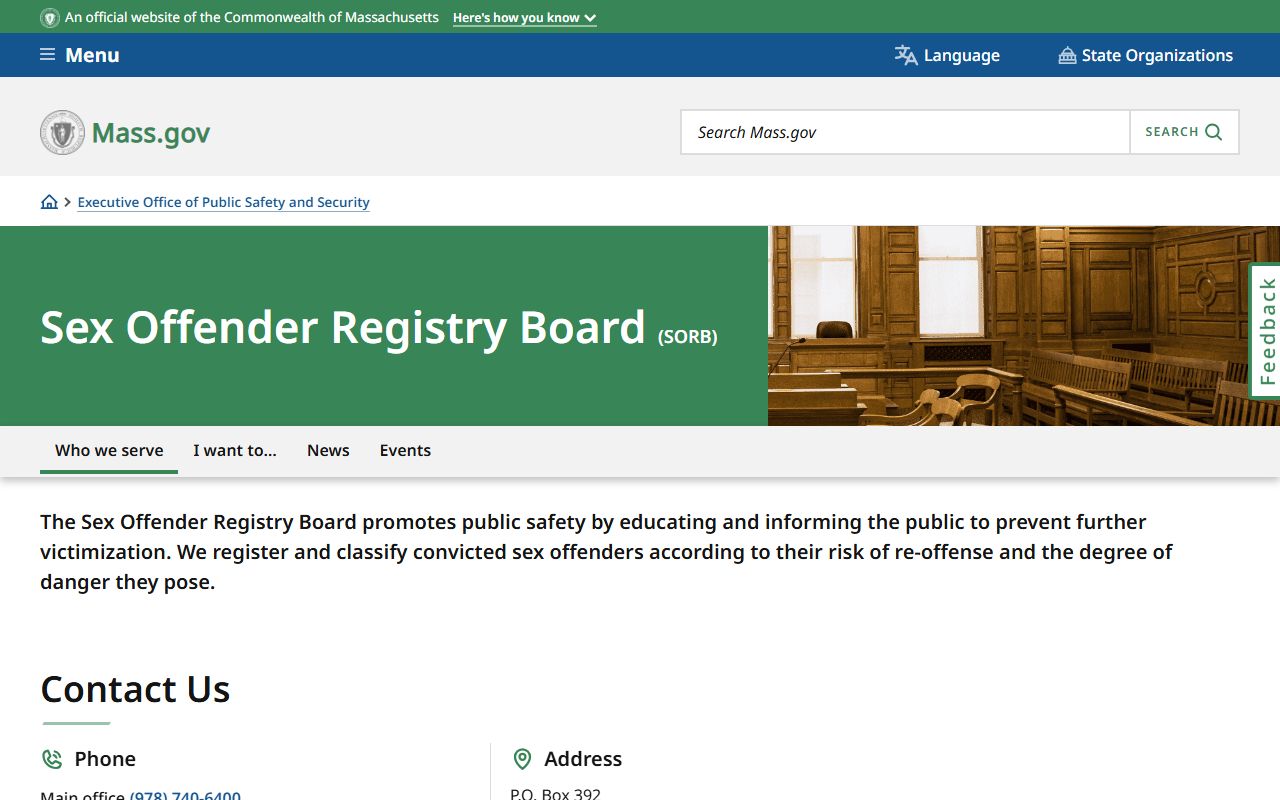
The Sex Offender Registry Board operates under M.G.L. c.6, § 178D and § 178J, which set out the registration framework and the public search rights that are separate from arrest records or criminal court files.
CORI vs. the Court Docket in Middlesex
One of the most common points of confusion in Massachusetts is the difference between a CORI report and a court docket. They are not the same thing. A court docket in MassCourts eAccess shows what happened in one case in one court department. A CORI report is a compiled criminal-history record assembled by the Department of Criminal Justice Information Services from records across courts and agencies. The two can tell different stories, and neither gives you the full picture that the other gives.
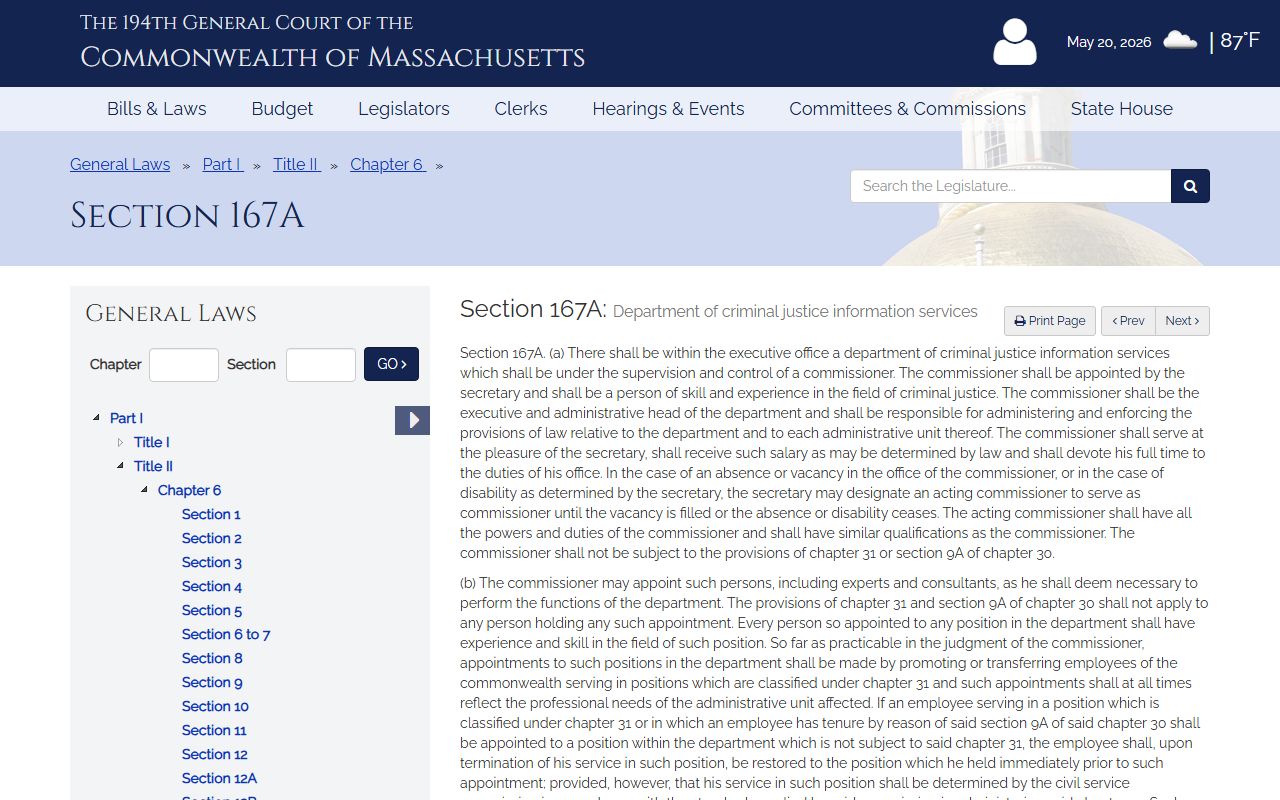
M.G.L. c.6, § 167A defines the terms used in the CORI law. "Criminal offender record information" has a specific statutory definition that includes records and data compiled by criminal justice agencies about certain adult criminal proceedings. Not every entry on a court docket qualifies. Not every arrest that shows on a police blotter ends up in a CORI report. The definitions matter because they control what DCJIS assembles and what gets disclosed.
The official CORI definitions statute page at the Massachusetts General Laws shows the scope and limits of CORI as the state defines it. The CORI definitions page at malegislature.gov explains what qualifies as criminal offender record information under Massachusetts law.
Who sees what in a CORI report is controlled by M.G.L. c.6, § 172. Employers, housing providers, schools, licensing boards, law enforcement, courts, and the individual subject do not all see the same level of detail. An employer running a background check through DCJIS sees a different output than a law-enforcement agency would. A plain court-docket search through MassCourts is available to anyone with internet access and is not the same as a CORI check for employment or housing.
Key distinction: A public docket search may show that a criminal case existed in Middlesex, but it does not replicate a CORI report. For official Massachusetts criminal history used in employment, housing, or licensing, use the DCJIS CORI process, not a court-docket lookup.
Sealed vs. Expunged Records in Massachusetts
Massachusetts law treats sealing and expungement as two distinct processes, and mixing them up causes real problems for people trying to clean up their records. Sealing limits who can see a record, but the record still exists. Expungement is narrower and can result in the destruction or deletion of a record under stricter criteria. The process you pursue, and what you can get, depends on the type of case, the outcome, how much time has passed, and your current legal status.
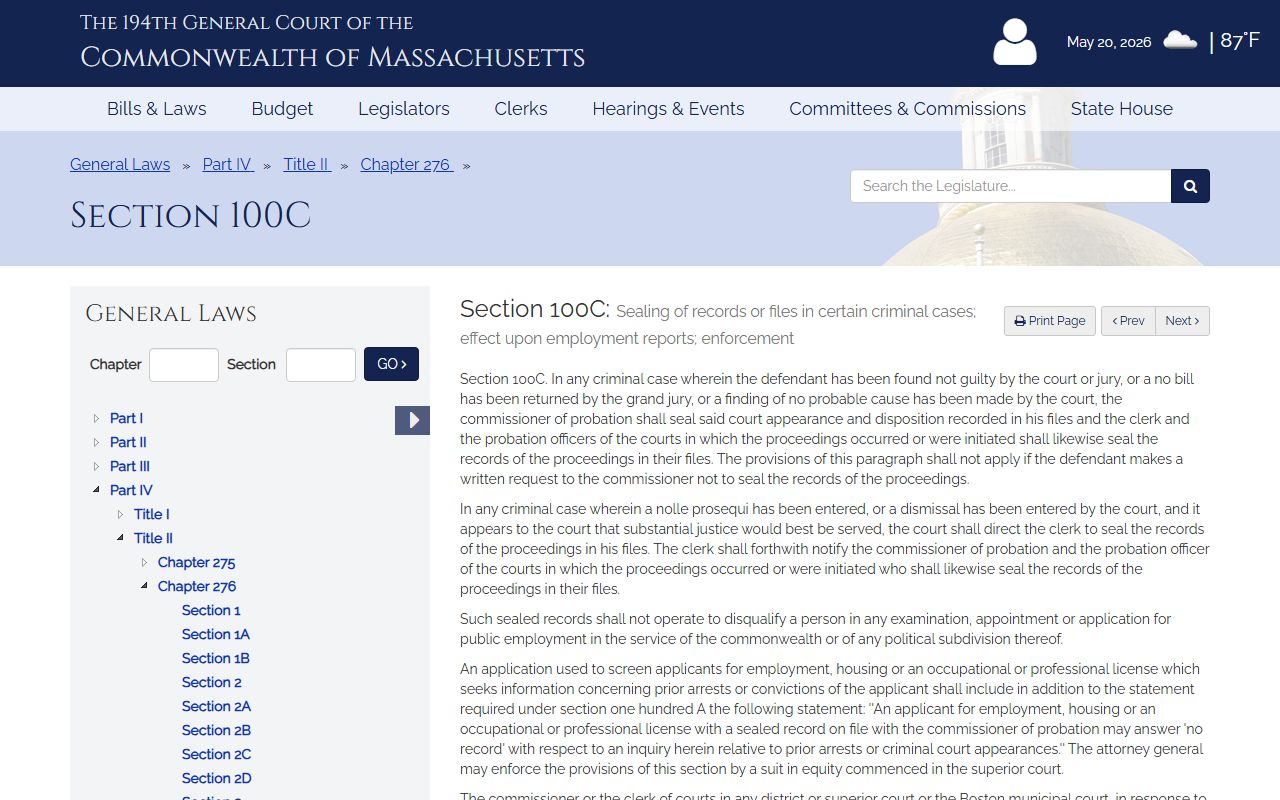
For dismissed cases, acquittals, no bills, and no-probable-cause findings, the sealing path is under M.G.L. c.276, § 100C. This statute lets a person petition to seal a record after certain non-conviction outcomes without the long waiting period required for conviction sealing. It is one of the most relevant tools for someone whose arrest did not lead to a guilty finding but whose record still shows the arrest and charge.
The Massachusetts General Laws page for § 100C explains the sealing process for dismissed and non-conviction outcomes. The court sealing statute at malegislature.gov sets out the eligibility rules and the petition process.
For older convictions, the sealing route is M.G.L. c.276, § 100A, which requires a waiting period after the sentence is served and the person has no new criminal activity. The waiting period depends on the offense class. Common reasons for denial include an ineligible offense, an insufficient waiting period, an open criminal matter, or filing in the wrong court. These rules are technical enough that legal help is wise before filing.
| Sealed | Expunged | |
|---|---|---|
| Effect | Record hidden from public; still exists in the system | Record destroyed or deleted under statutory criteria |
| Public Visibility | Not visible to employers or public | Treated as if it never existed (strict eligibility) |
| Law Enforcement Access | Limited authorized access retained | Very limited; stricter than sealing |
| Eligibility Base | Broader; covers more offense types | Narrower; limited by statute to certain cases |
| Key Statutes | M.G.L. c.276, § 100A (convictions); § 100C (dismissals) | Separate expungement provisions in Massachusetts law |
| Juvenile Records | M.G.L. c.119, § 60A applies separately | Separate juvenile rules; not merged with adult process |
A dismissed Middlesex case is not automatically invisible. The person may need to file a petition and meet the criteria under § 100C. Mistakes in filing can delay relief, so the Committee for Public Counsel Services and legal aid organizations can help navigate the process.
What Is and Is Not Public in Middlesex Arrest Records
Massachusetts public access works in layers, and arrest records sit across more than one layer. The Massachusetts Public Records Law, primarily in M.G.L. c.4, § 7(26), covers executive-branch agencies including police departments and the Sheriff. But the Law lists exemptions. The investigatory exemption can shield arrest materials while a case is under investigation. The privacy exemption can protect personal details. And separate court rules govern what the clerk shows you once a case is docketed.
Categories that are not open to a general search include juvenile records, sealed and expunged records, materials from an open investigation, grand jury proceedings, active search warrants that have not been returned, and medical or mental-health information gathered at booking. The Sheriff's booking record can be requested as a public record but may come back with redactions for protected health information, security housing details, classification notes, PREA materials, and victim information. Even when a court docket is public, the police report and booking paperwork attached to the same incident may be withheld or redacted.
- Generally public: arrest charge, booking date, arresting agency, case docket number after arraignment, dispositions in adult court cases.
- May be withheld or redacted: booking photos under investigation, victim information, medical screening at intake, security classification, arrest reports from open investigations.
- Closed by law: juvenile records, sealed records, grand jury materials, adoption records, mental-health commitment records.
When a record falls in the middle, such as an arrest that was not charged or was dismissed early, the person often needs to take action, such as petitioning for sealing, to stop that arrest from appearing in background checks.
The DA and Public Defense in Middlesex County
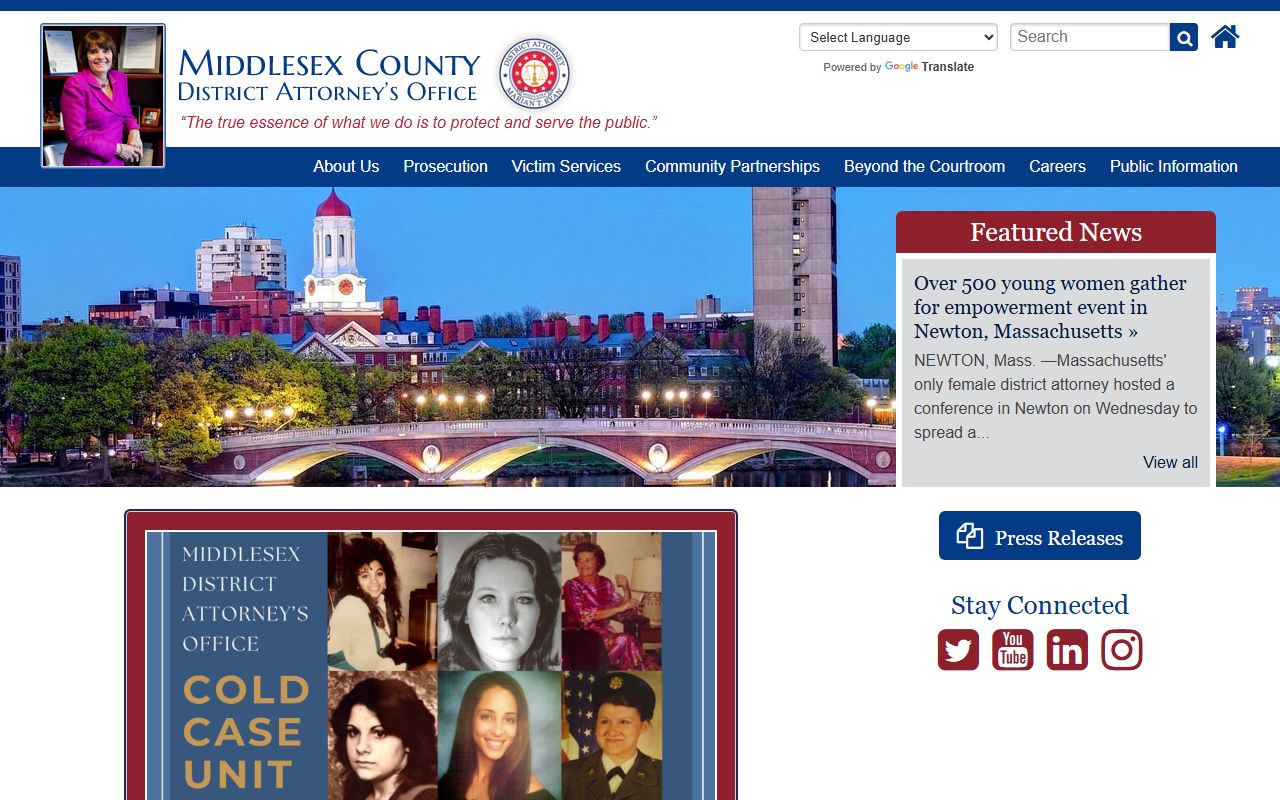
The Middlesex District Attorney's Office is the state agency that decides whether to file criminal charges and how to prosecute them. The current District Attorney is Marian T. Ryan. The office handles all state criminal cases in Middlesex County, from misdemeanors in District Court to serious felony indictments in Superior Court. The DA's office also runs victim and witness services, community programs, and press releases on significant arrests. Press releases from the DA's office are sometimes one of the few public-facing summaries of a Middlesex arrest, particularly for high-profile cases.
The official website for the Middlesex District Attorney is middlesexda.com. Victim/Witness Services are described at the victim-witness services page, and the DA's public-records contact is at middlesexda.com/services/public-records for requests directed to the DA's administrative records.
The Middlesex DA website and the office's public records contact are shown at middlesexda.com, which is the main resource for press releases, diversion programs, and victim services in the county.
On the defense side, public defense in Massachusetts runs through the Committee for Public Counsel Services (CPCS) at publiccounsel.net. CPCS appoints public defenders and assigned counsel for eligible adults and juveniles in criminal, delinquency, child welfare, mental health, and related matters. Eligibility is determined by court indigency screening. CPCS is not the same as the Clerk-Magistrate or the DA; each plays a separate role in the process. People who cannot afford an attorney and face criminal charges in Middlesex should ask the court to appoint counsel at arraignment.
Background Check Considerations for Middlesex Records
An arrest record is not a conviction. That matters a great deal in background checks used for employment, housing, or licensing. Massachusetts law limits how employers and housing providers can use CORI information, and federal law under the Fair Credit Reporting Act sets additional rules when a consumer reporting agency is involved. A Middlesex arrest that did not result in a conviction may still surface in a background check if the record has not been sealed, and the person has a right to review and dispute their own CORI information through DCJIS.
People who want to know what their own Massachusetts criminal history shows can request their own CORI from DCJIS. The result is the official Massachusetts criminal history record, not just a single-court docket. That self-request process exists separately from a public web search and gives the most complete picture of what a background-check user authorized under CORI law would see.
Important: This website is not a consumer reporting agency and may not be used for FCRA-regulated purposes including employment screening, tenant evaluation, or credit decisions.