
Getting a Marriage License in Middlesex County
Marriage licenses in Massachusetts are not issued by Middlesex County. They are issued by city and town clerks. A couple may apply at any Massachusetts city or town clerk's office, and the license is valid for a ceremony anywhere in the state. That means Lowell, Cambridge, Newton, Woburn, Framingham, and every other Middlesex municipality each handle their own marriage intentions and licenses. The county itself plays no role in issuing the license or recording the ceremony. The state's official overview of the process is at mass.gov/how-to/get-a-marriage-license.
Because each city and town sets its own local fee, there is no single Middlesex County marriage license fee to quote. Fees vary by municipality. Call or check the website of the specific city or town clerk where you plan to file before you go. Do not rely on a neighbor's experience from a different town as a fee guide, since amounts can differ and may change year to year.
The waiting period also matters. Massachusetts law requires a waiting period after filing the marriage intention before the license can be used. A court may grant a waiver in certain situations, but couples should plan for the standard period when scheduling a ceremony date.
How to Apply for a Marriage License
The process flows through the local clerk's office. Both parties do not always have to appear at the same time, but practices vary by city and town, so confirm the local procedure first. Having all documents ready before you go saves a second trip.
- Choose a Massachusetts city or town clerk's office. For Middlesex County residents, common options include the clerks in Lowell, Cambridge, Newton, Woburn, Framingham, Malden, Somerville, or another municipality where you live or prefer to file.
- Visit the clerk in person to file the marriage intention, unless the clerk's office has approved an alternate process. Most offices require at least one applicant to appear.
- Bring valid government-issued photo identification for both applicants. If either party was previously married, bring documentation of how that marriage ended, such as a divorce decree or a death certificate.
- Complete the marriage intention form with all required fields. The form collects full legal names, addresses, dates and places of birth, parents' names, prior marriage history, and intended ceremony details.
- Sign the marriage intention under oath as required by the clerk. Both parties must attest that the information is correct.
- Pay the local clerk's filing fee. The fee is set by each municipality, so confirm the amount before your visit.
- Wait out the Massachusetts statutory waiting period after filing, unless a court has granted a waiver. The license becomes valid once the waiting period ends.
- Use the license for a ceremony performed in Massachusetts. After the ceremony, the officiant completes and returns the license to the issuing clerk for recording.
- Order certified copies from the issuing city or town clerk, or through the Registry of Vital Records and Statistics if the record has been forwarded to the state.
Note: Some town clerks have updated their intake process to allow online pre-filing of certain information, but in-person signature and oath are typically still required at some stage.
Marriage License Application Field Inventory
When you appear at the city or town clerk's office, the marriage intention form asks for a standard set of vital-record fields. The table below reflects the field inventory for Massachusetts marriage license applications. Every field marked "yes" in the Required column must be filled in correctly, since errors on the form can cause delays or require corrections before the ceremony.
| Field Label | Type | Required | Notes |
|---|---|---|---|
| Applicant 1 full legal name | Text | Yes | As shown on government-issued ID. |
| Applicant 2 full legal name | Text | Yes | As shown on government-issued ID. |
| Address | Text | Yes | Current residential address for each applicant. |
| Date and place of birth | Text / date | Yes | Standard vital-record field; both applicants. |
| Parents' names | Text | Yes | Including birth and maiden names as required by the clerk. |
| Prior marriage status | Checkbox / text | Yes | Divorce, death, or annulment information if any prior marriage exists. |
| Intended date and place of ceremony | Text / date | Often requested | Used for license processing and planning. |
| Officiant | Text | Optional / may be known later | Can be completed or returned after ceremony by some clerks. |
| Oath and signature | Signature | Yes | Marriage intention signed under oath before the clerk. |
| Fee payment | Payment | Yes | Local clerk fee; call the specific municipality to confirm amount. |
Massachusetts Vital Records and Marriage Certificates
After the ceremony, the clerk records the marriage and the record becomes part of the Massachusetts vital statistics system. The Registry of Vital Records and Statistics, part of the Massachusetts Department of Public Health, holds statewide vital records including marriage records. Certified copies of marriage certificates can be ordered from the city or town that issued the license or from RVRS if the record has been forwarded there. The RVRS also holds birth and death records, and the ordering process for all three is similar.
The official RVRS page at mass.gov/orgs/registry-of-vital-records-and-statistics explains what the office holds, who may order records, what identification is needed, and how to submit a request. Requests can be made in person, by mail, or through the state's online ordering system depending on the record type and how far back the record dates.
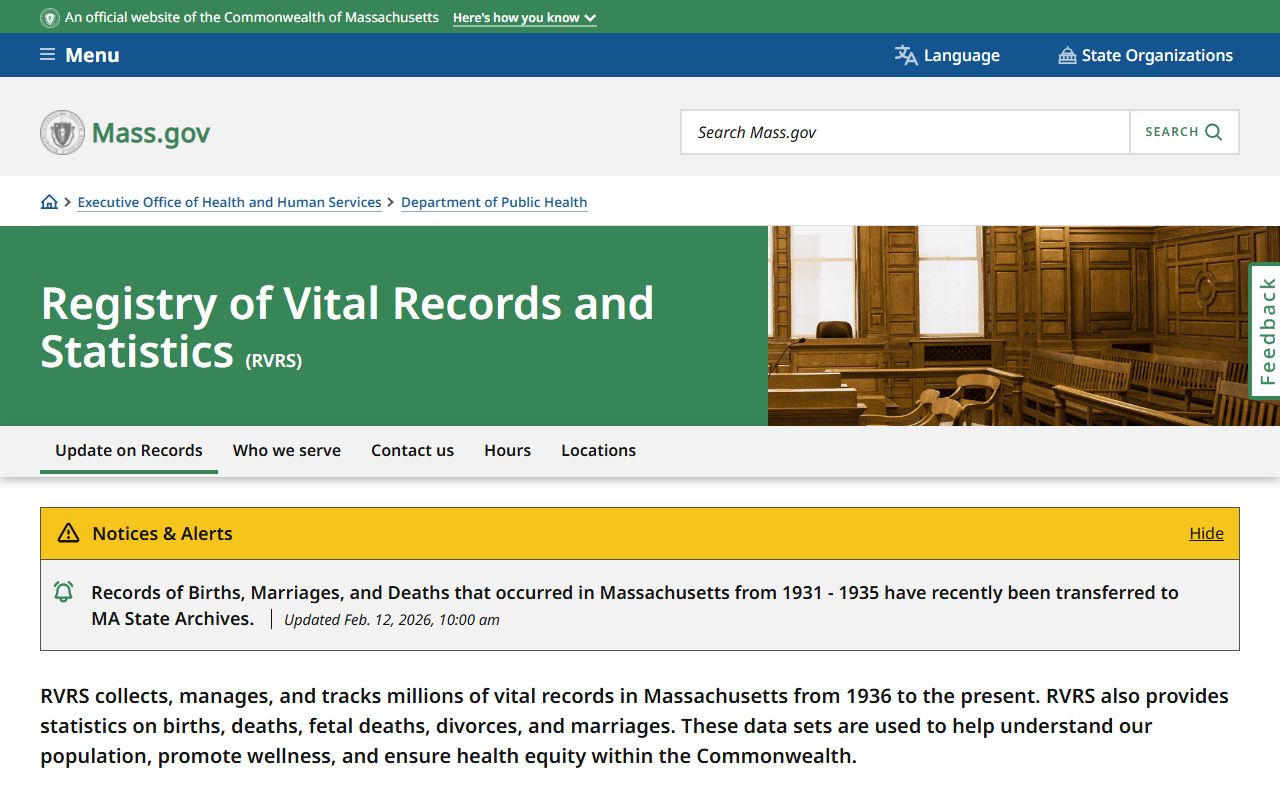
The RVRS page is also useful for confirming which years are indexed in the state system versus records that remain only at the local clerk's office. Older Middlesex marriage records may require going directly to the town where the intention was filed.
The state's step-by-step instructions for ordering a birth, marriage, or death certificate are at mass.gov/how-to/order-a-birth-marriage-or-death-certificate. That page spells out eligible requesters, accepted forms of ID, the fee structure, and delivery options.
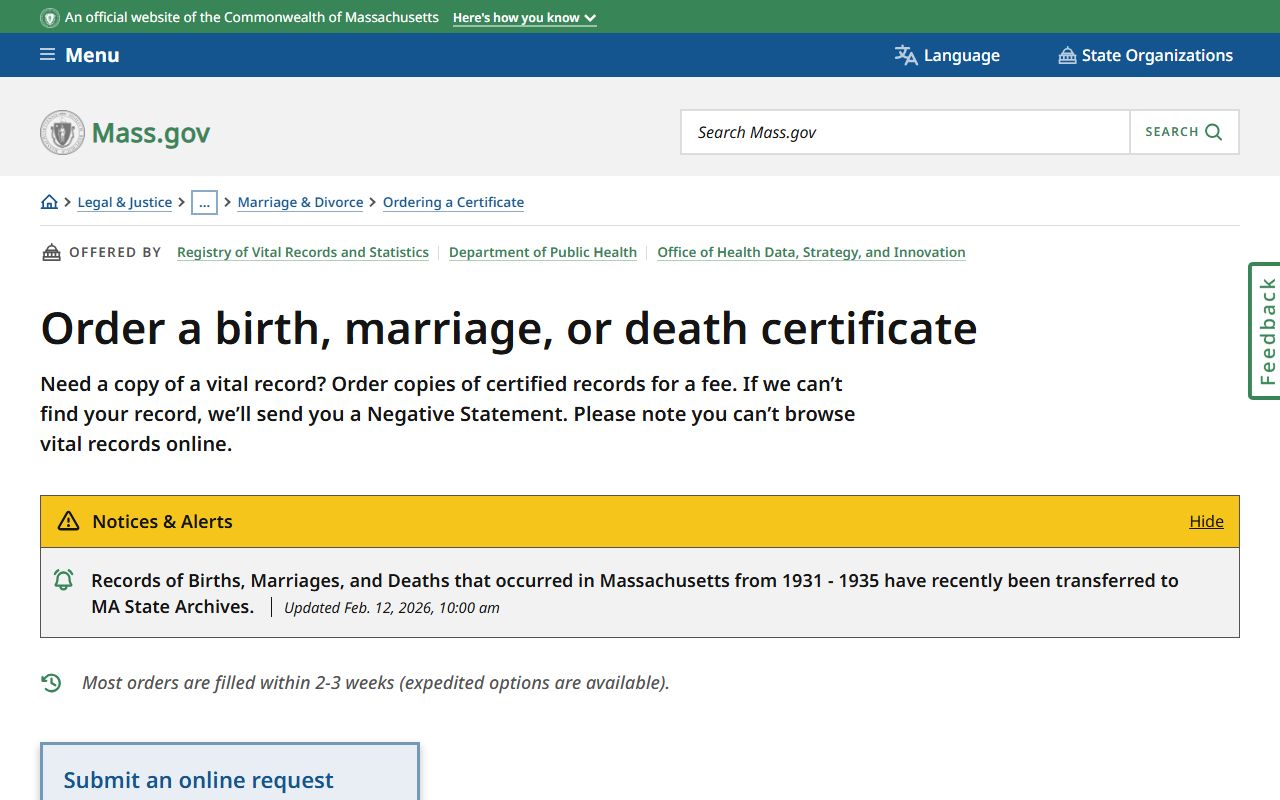
For a certified copy to be accepted by a bank, consulate, or other institution, confirm that you are ordering a certified copy rather than an informational copy, since uncertified copies are not accepted for many official purposes.
Middlesex Marriage and Divorce Record Fees
There is no single county fee for marriage or divorce records in Middlesex. Fees are set by two separate systems depending on the record type. Marriage license fees are set by each city and town clerk. Divorce record fees are set by the Probate and Family Court department under the Massachusetts Trial Court fee schedule.
Because fees vary by office and can change, the table below describes how each fee is determined rather than listing a dollar amount that might be outdated or wrong for a specific municipality.
| Item | Who Sets the Fee | How to Confirm |
|---|---|---|
| Marriage license filing fee | City or town clerk | Call or check the website of the specific municipality where you plan to file. |
| Certified marriage certificate copy | City or town clerk, or RVRS | Check the issuing clerk's fee schedule or the RVRS ordering page. |
| Divorce record copy (plain) | Middlesex Probate and Family Court | Contact the court clerk or review the current Trial Court fee schedule. |
| Certified or attested divorce copy | Middlesex Probate and Family Court | Higher rate than plain copy; confirm with the Probate and Family Court register's office. |
| Divorce docket printout | Middlesex Probate and Family Court | Per-page rate; confirm with the clerk. |
| Fee waiver | Court, via affidavit of indigency | File an affidavit of indigency if you cannot afford court fees; waiver availability varies by proceeding. |
If you need a certified copy for immigration, a name-change request, or an out-of-state court, ask the issuing office which copy type meets the receiving agency's requirement before you pay.
Divorce Records in Middlesex Probate and Family Court
Divorce records in Middlesex County are Probate and Family Court records. They are not held by the Superior Court, the District Court, or a county clerk. The Middlesex Probate and Family Court has two sitting locations: the Lowell courthouse and the South Woburn courthouse. Both handle divorce, legal separation, and related family matters for Middlesex County residents. Which location holds your file depends on where the case was filed.
A divorce file can contain a range of documents. The complaint for divorce is usually the first filing, followed by the summons and service return, financial statements, a separation agreement if the parties reached one, a child support worksheet, a parenting plan, temporary orders, motions, a judgment nisi, and the judgment absolute. The judgment nisi is the preliminary divorce judgment issued by the court. Under Massachusetts law, the judgment nisi becomes absolute after the statutory waiting period has passed, converting the preliminary judgment into a final divorce decree. Most people use the terms "divorce decree" to mean the judgment absolute.
Massachusetts recognizes both no-fault and fault-based divorce grounds. No-fault divorce, based on irretrievable breakdown of the marriage, is the most common path. Fault grounds also exist under state law, though they are used less often. M.G.L. c.208, Section 5 governs residency and jurisdiction requirements for divorce filings. The statute sets out where a couple may file based on how long they have lived in Massachusetts. The Probate and Family Court department page provides an overview of the full range of matters the department handles.
For filing a divorce, forms and instructions are available through the Trial Court forms library. The right form depends on whether the divorce is contested or uncontested and whether children are involved. Self-represented litigants can also get help navigating the forms at a Massachusetts Court Service Center.
Divorce Jurisdiction and Residency in Middlesex County
Before a Middlesex court can grant a divorce, the filing must meet the jurisdiction and residency requirements set by state law. These rules determine whether Middlesex Probate and Family Court is the right place to file or whether another county's division is proper.
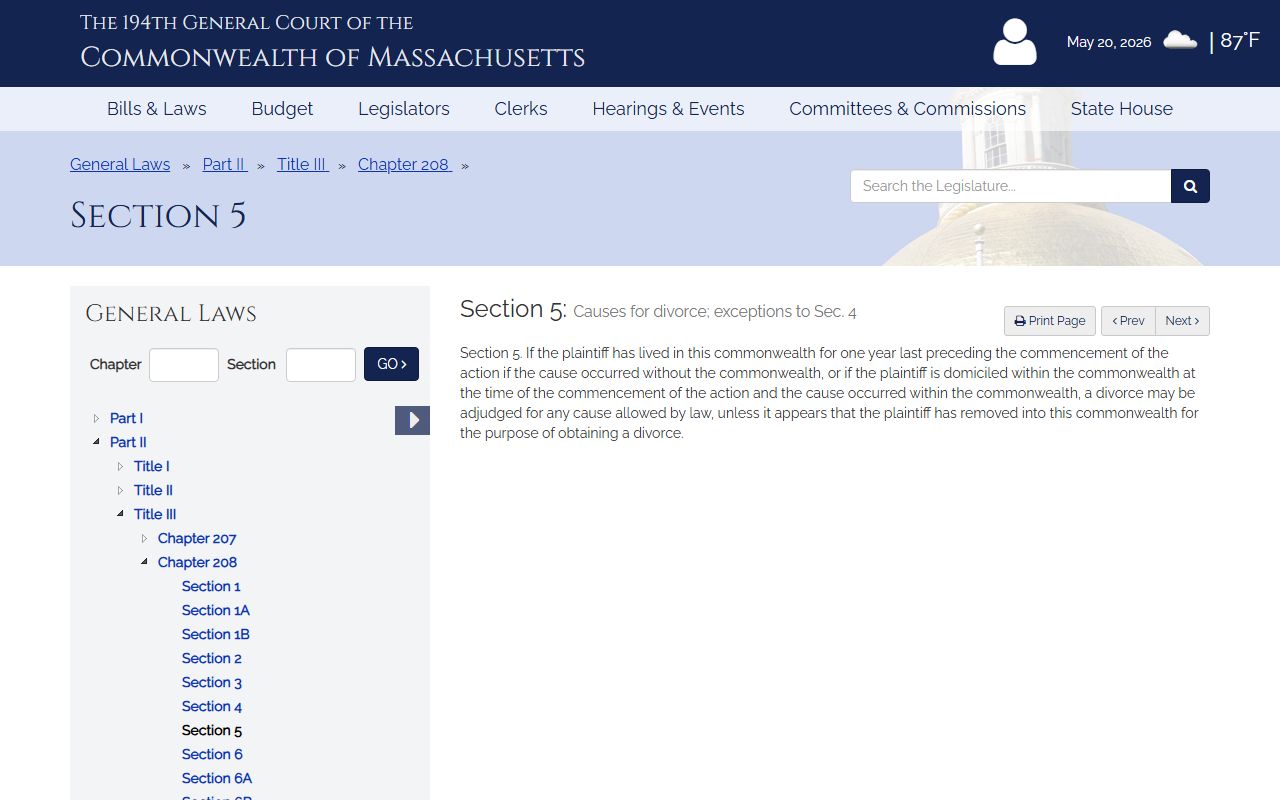
The official text of the residency and jurisdiction statute is published on the Massachusetts Legislature's website. M.G.L. c.208, Section 5 sets out the conditions under which a Massachusetts court may hear a divorce petition, including how long a party must have lived in the state and which county is the proper venue. Reading the statute before you file can prevent a case from being dismissed or transferred for improper venue.
If venue is proper in Middlesex, file with the Middlesex Probate and Family Court. The Middlesex Probate and Family Court location page confirms the courthouse address, phone number, and hours for the Lowell location, and the South Woburn location page covers the second courthouse. Both locations handle divorce filings, but the register's office can tell you which is appropriate for your address.
For deeper context on how the Middlesex Probate and Family Court handles estate and family matters that often arise alongside a divorce, see the Middlesex County Probate and Family Court records page.
How to Request a Copy of a Middlesex Divorce Record
The Massachusetts official instructions for obtaining a copy of a divorce record are on Mass.gov. The state page at mass.gov/how-to/get-a-copy-of-your-divorce-record explains the process, which offices can provide copies, and what to bring or include with your request.
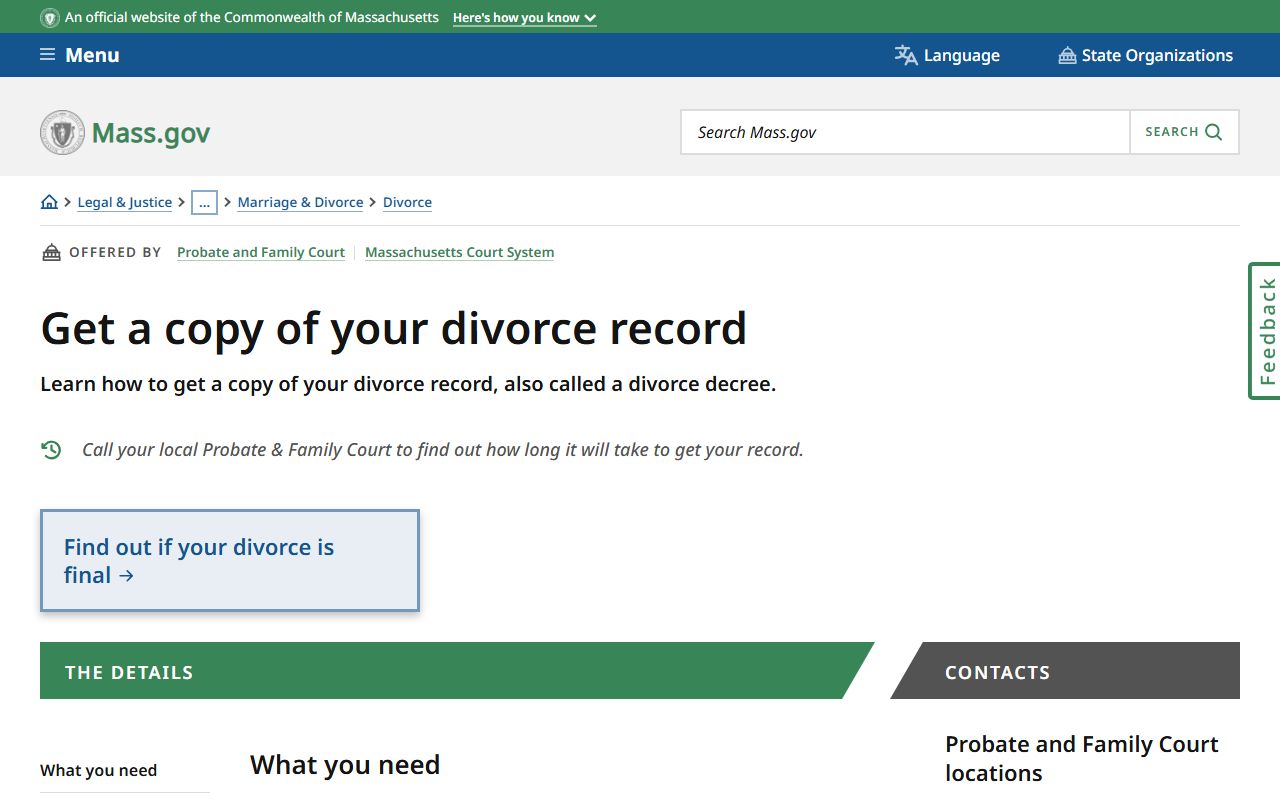
That page is maintained by the state and reflects current procedures, so it is the most reliable starting point before you contact a clerk. The Middlesex Probate and Family Court register's office handles copy requests for Middlesex cases specifically. You can contact the court by phone or in person at either the Lowell or South Woburn location to ask about your specific file before submitting a request.
The table below shows the standard fields asked when requesting a Middlesex divorce record copy. Having this information ready before you call or visit speeds the process considerably.
| Field Label | Type | Required | Notes |
|---|---|---|---|
| Party 1 name | Text | Yes | Name as it appears on the divorce filing; may differ from current legal name. |
| Party 2 name | Text | Yes | Name at time of divorce. |
| Court county / division | Text / dropdown | Yes, if known | Middlesex Probate and Family Court; specify Lowell or South Woburn if known. |
| Docket number | Text | Optional but strongly preferred | Speeds the search significantly; find it on MassCourts eAccess if you have access. |
| Year of divorce | Number / date | Strongly recommended | Needed for older files; archive retrieval may take additional time. |
| Copy type requested | Checkbox | Yes | Plain copy, certified or attested copy, decree only, full docket, or judgment nisi / judgment absolute. |
| Requester contact information | Text / email / phone | Yes | Needed for fee notification and delivery arrangements. |
| Payment | Instruction | Yes if fee due | Follow current Probate and Family Court payment instructions; confirm accepted payment methods with the clerk. |
Note: Divorce records are generally accessible to the parties and their attorneys. Third-party access to some documents may require a court order or showing of need, particularly for records that contain financial statements or other restricted materials.
Restricted Records in Middlesex Family Cases
Not every document in a Middlesex Probate and Family Court divorce file is open to public view. Several categories of materials are routinely restricted or sealed by court rule, standing order, or specific impoundment order. Knowing which documents are restricted before you request a file avoids confusion and wasted trips.
Financial statements are among the most commonly restricted documents in divorce cases. Each party is typically required to file a financial statement, but these are confidential under Trial Court rules and are not available to the general public. Child-related information, including a child's name, date of birth, school, and home address, is protected. Documents related to domestic violence, including any affidavits supporting a restraining order filed within the divorce case, are also restricted. Impounded filings, medical records submitted to the court, and sealed portions of the file follow the same rule.
The docket itself, which shows the list of filings and hearing dates, is generally public. But a public docket entry for a financial statement does not make the statement itself public. A person reviewing a Middlesex divorce docket on MassCourts eAccess may see that a financial statement was filed without being able to read its contents.
If a document you need has been impounded or sealed, the correct step is to file a motion with the Middlesex Probate and Family Court explaining your need. The court decides whether access is proper. For broader context on what is and is not public in Massachusetts court filings, the Middlesex County public records page covers the framework in more detail. Questions about court-specific rules can also be directed to the Clerk of Court.
Important: Financial statements, records identifying minor children, domestic-violence materials, and impounded filings in Middlesex Probate and Family Court divorce cases are confidential and are not released on request to the general public.
Common Forms for Middlesex Marriage and Divorce
The Massachusetts Trial Court forms library organizes court forms by department. For marriage-related matters, the relevant forms come from city and town clerks rather than the state court system. For divorce and family matters, forms are in the Probate and Family Court section of the library.
Common divorce-related forms include the complaint for divorce, the financial statement, the separation agreement, the child support guidelines worksheet, the parenting plan, and the affidavit of indigency for those seeking a fee waiver. The Trial Court has separate forms for contested and uncontested matters, and for cases with and without children. The Trial Court forms library is the authoritative source and is updated when forms change. Do not rely on forms downloaded from unofficial sites.
Legal aid organizations can also help Middlesex residents navigate which form applies to their situation. Several groups provide assistance in the county.
- MassLegalHelp provides plain-language guides on divorce, custody, and family court forms.
- Greater Boston Legal Services offers civil legal aid for eligible Middlesex County residents.
- MetroWest Legal Services serves Framingham, Natick, and the broader MetroWest area of Middlesex.
- Massachusetts Court Service Centers help self-represented people find and complete court forms; the Lowell Court Service Center serves many Middlesex users.