
How to Look Up Middlesex County Jail Population Data
No live dashboard publishes the Middlesex County jail headcount. The Sheriff's official site at middlesexsheriff.org describes the facility's role and accreditation but does not post a real-time or even monthly population number. That is not unusual for Massachusetts county jails. The state does not run a centralized public jail-population dashboard the way some states do.
The closest official sources for population data are the Sheriff's annual report, budget documents submitted to the county or state, and inspection reports produced by accrediting bodies. The Bureau of Justice Statistics publishes the Census of Jails and the Annual Survey of Jails, which are the most consistent national tracking tools and include Massachusetts county facilities. The Vera Institute of Justice has published state and national jail-population trend data drawing on the same BJS surveys. Those sources do not update in real time, but they give a verified baseline. Anyone needing a current Middlesex County figure should contact the Sheriff's Office directly or request records through the public-records process at middlesexsheriff.org/238/Public-Records.
Middlesex County Jail Capacity Overview
The Middlesex Jail and House of Correction in Billerica is the county's one correctional campus. The facility is accredited by the American Correctional Association and the National Commission on Correctional Health Care, which means it passes periodic inspections that evaluate physical plant, programming, health care, and management. Accreditation does not automatically make capacity or population figures public, but inspection reports can be requested and may contain bed counts.
Data Gap Notice: Research of the official Middlesex Sheriff website found no published capacity number, daily population count, or occupancy rate on any public web page. The table below reflects the facility units the Sheriff identifies publicly. Capacity figures are not fabricated. Readers who need verified capacity data should request the Sheriff's most recent annual report, state jail-inspection files, or BJS Census of Jails data for Massachusetts county facilities.
| Facility / Unit | Role | Rated Capacity |
|---|---|---|
| Middlesex Jail and House of Correction | Men awaiting trial; men serving sentences up to 2½ years | Not published on official page |
| Women's Pre-Release Center | Women classified to pre-release programming | Not published on official page |
| Housing Unit for Military Veterans (HUMV) | Veteran-specific housing and programming | Not published on official page |
| Older Adult Re-Entry Unit | Reentry support for older incarcerated people | Not published on official page |
The Sheriff's annual report and state budget documents are the most likely places to find a published bed count. Request them through the public-records process at middlesexsheriff.org/238/Public-Records, or look for the most recent published BJS Census of Jails for Massachusetts.
Average Daily Population
The average daily population, or ADP, is the standard measure jails use to describe how many people are in custody on a typical day. It smooths out the noise from weekend spikes, holiday releases, and court-day transfers. The BJS Annual Survey of Jails collects ADP figures from county jails across the country, including Massachusetts facilities. Those surveys are published periodically and can be found at the BJS website. For Middlesex County specifically, the Sheriff's Office would be the source for a current or recent ADP. No ADP figure for the Middlesex Jail was found on a public web page during research. The BJS data tool at bjs.gov allows users to pull state and county jail statistics from survey years going back to the 1980s and is the best public option short of a direct records request.
ADP varies by season and by events upstream in the system. An increase in arrests, a slowdown in court processing, or a tightening of bail conditions can push ADP up quickly. A diversion program, a bail-reform policy, or a reduction in new bookings can pull it down. Neither direction is automatic. The right reading of any ADP figure requires knowing what was happening in the courts and in the community at the same time.
Demographic Breakdown
Demographic data for the Middlesex County jail, such as gender split, age distribution, and racial composition, is not published on the official Sheriff's website. No breakdown was located in a public web page during research. At the national level, BJS data consistently shows that county jails hold a majority of men, with a smaller and growing share of women. Age tends to cluster in the 25 to 44 range across most American jails. These are national patterns, not verified Middlesex figures.
The Middlesex facility does serve a distinct gender population in at least two ways. Men awaiting trial and men serving sentences up to two and a half years make up the main population. Women classified to the pre-release program are housed in the Women's Pre-Release Center, which is a separate program with its own services. That structural split means the overall population is not a single undifferentiated group. The Sheriff's annual report or a public-records request would be the right avenue to get a verified demographic count for any given year.
Pretrial vs. Sentenced Population in Middlesex
The Middlesex Jail and House of Correction holds two legally distinct groups. The first is people who have been charged but not yet convicted. They are there because bail was set and not posted, or because they were held without bail by a judge. They have not been found guilty of anything. The second group has been sentenced: people convicted and serving time under a sentence of up to two and a half years. Massachusetts law sends people sentenced to more than two and a half years to a Massachusetts Department of Correction state prison, not to the county jail.
| Population Type | Legal Status | Why They Are Here |
|---|---|---|
| Pretrial detainees | Charged, not convicted | Bail not posted or held without bail by court order |
| Sentenced population | Convicted, serving sentence | Sentence of 2½ years or less under Massachusetts law |
The share of pretrial versus sentenced people in any jail fluctuates with bail policy, case volume, and the speed of court processing. Research did not locate a published pretrial-to-sentenced ratio for the Middlesex facility. At the national level, the BJS reports that pretrial detainees have made up a growing share of jail populations over the past two decades, sometimes exceeding 70% of total jail occupancy in many jurisdictions. Whether that trend holds for Middlesex would require the Sheriff's own data.
Note: Probation detainers and civil commitment holds can add a third category of people who are neither clearly pretrial nor serving a standard sentence.
Misdemeanor vs. Felony Population
County jails in Massachusetts hold people charged with or convicted of both misdemeanors and felonies, depending on bail outcomes and sentencing. A person charged with a serious felony and held without bail sits in the same facility as someone serving a short sentence for a misdemeanor. Sentence length, not offense severity alone, determines whether a sentenced person goes to county jail or state prison in Massachusetts.
A specific misdemeanor-to-felony breakdown for the Middlesex jail is not available on the official Sheriff's website. The BJS Census of Jails collects some charge-type data from facilities but the published tables are usually at the state or national level rather than by individual county. The Sheriff's public-records office is the practical path to a county-specific figure if one has been captured internally. The request page is at middlesexsheriff.org/238/Public-Records.
Mental Health and Medical Population
The Middlesex Jail and House of Correction holds NCCHC accreditation from the National Commission on Correctional Health Care. That accreditation covers health services delivery standards, which include mental health screening, treatment access, and medical care. The Sheriff's site lists a Health Services Unit as part of the facility's organizational structure, alongside programming for addiction and behavioral health.
Nationally, BJS data from the Survey of Jails finds that a substantial portion of jail populations have some form of mental health need, and jails have become de facto crisis-stabilization points for people who enter the system during a behavioral health episode. The Middlesex Sheriff has addressed this at the system level through the Restoration Center of Greater Lowell at 10 Technology Drive in Lowell, announced in March 2026 as a low-barrier diversion site for substance-use and mental-health crises, designed to reduce jail use for people who primarily need health services.
A specific mental-health-population count for the Middlesex facility is not published on a public web page. NCCHC accreditation standards do require that facilities track health data internally. Requests for that data would go through the Sheriff's public-records process.
Middlesex County Jail Programs and Special Units
Programming at the Middlesex Jail goes beyond basic confinement. The Sheriff's Office runs a range of programs that shape daily life inside the facility and matter to population analysis because they affect how people are classified, housed, and tracked. These are real, named units that the Sheriff identifies publicly, not generic descriptions.
The Programming page at middlesexsheriff.org/212/Programming lists the major categories: education, vocational training, addiction treatment, anger management, reentry services, family support, health services, victim services, and PREA compliance.
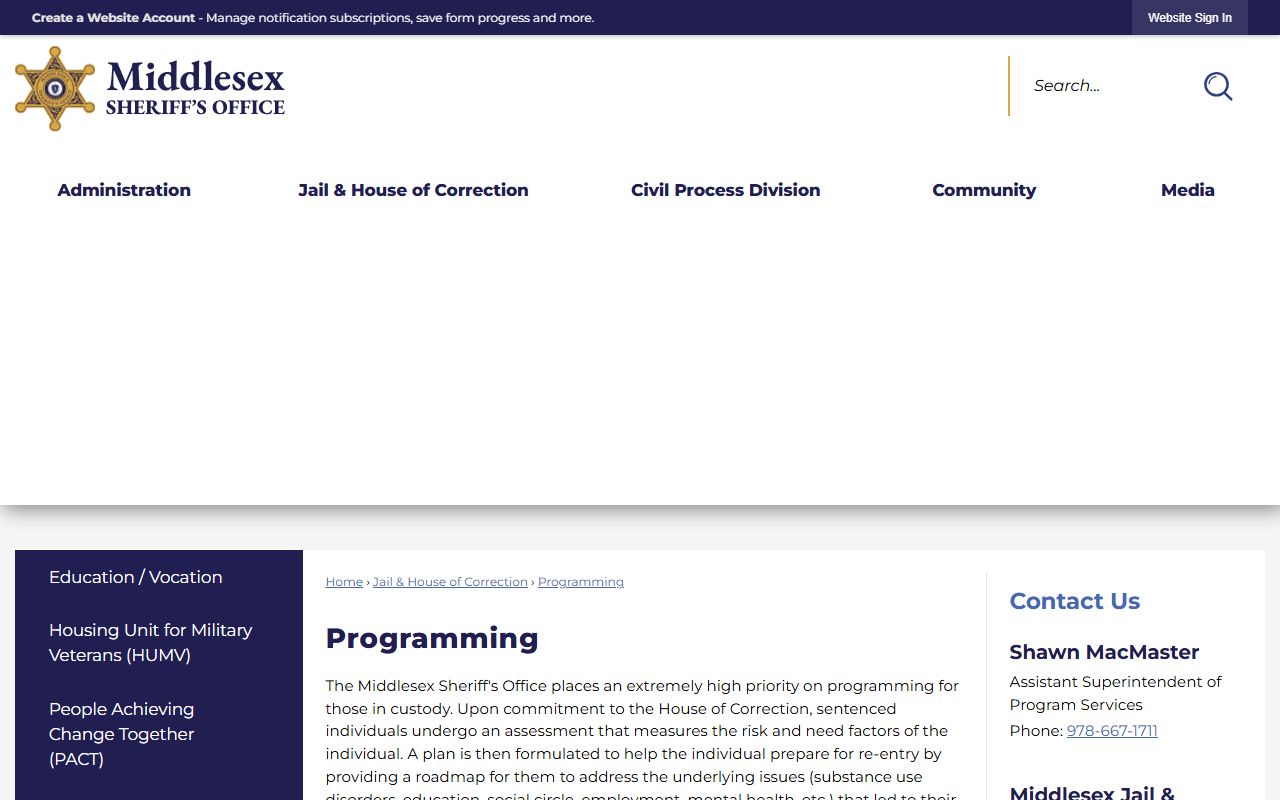
That programming overview reflects a facility that classifies and tracks participants in each area, which is part of how the Sheriff's data on the population gets built internally even when it is not published publicly.
The Women's Pre-Release Center is a separate program for women classified to pre-release status. Details are on the Women's Pre-Release Center page.
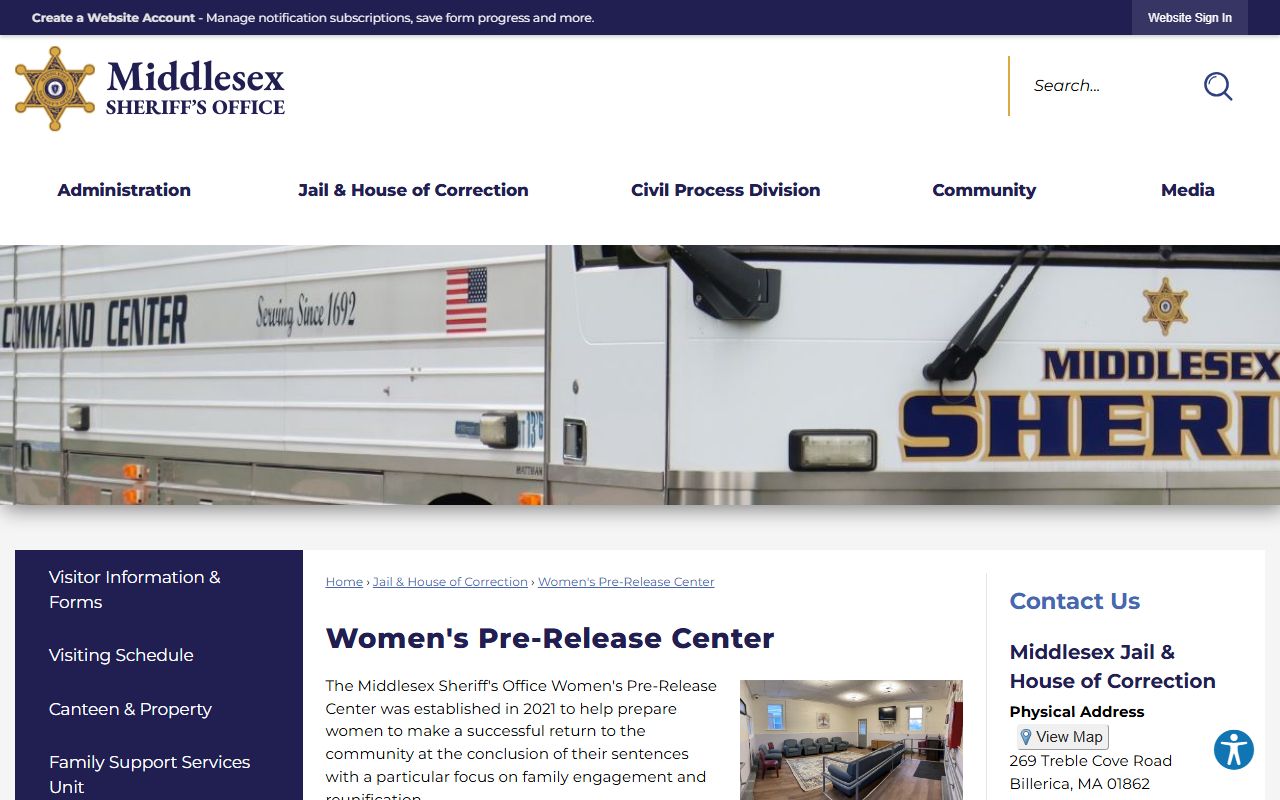
The pre-release model means some women in the Middlesex population are transitioning out of incarceration rather than serving time in a standard custody setting, which affects how that segment of the population count is interpreted.
The Housing Unit for Military Veterans is described on the HUMV page at middlesexsheriff.org.

The veterans unit houses people with military backgrounds together and provides programming tied to their service history, a model that is part of a national trend toward veteran-specific jail and reentry services.
- PACT – a cognitive behavioral and reentry programming track inside the facility.
- Project EARTH – an addiction and recovery track linked to reentry planning.
- Older Adult Re-Entry Unit – housing and reentry support for older incarcerated adults.
- Family Support Services Unit – services that keep family connections active during incarceration.
Each of these units represents a sub-population within the broader Middlesex County jail population. A person enrolled in PACT is tracked differently than a general-population detainee. That internal classification structure is part of why a simple "total count" does not capture how the facility actually operates.
Jail vs. Prison vs. Federal Custody in Massachusetts
The Middlesex County jail is one of three custody systems that can hold a person from Middlesex County, and they do not overlap. Knowing which system a person is in determines where to look.
| System | Who It Holds | How to Check |
|---|---|---|
| Middlesex County Jail (Sheriff) | Pretrial detainees; people sentenced up to 2½ years | Call jail at 978-667-1711; public-records request to Sheriff |
| Massachusetts DOC State Prisons | People sentenced to more than 2½ years | VINELink Massachusetts; Mass.gov DOC inmate search |
| Federal Bureau of Prisons | People convicted of federal crimes | BOP inmate locator at bop.gov |
The dividing line between county jail and state prison in Massachusetts is the two-and-a-half-year mark. That is different from many states that use a felony/misdemeanor split to determine where someone is sent. Someone convicted of a felony but sentenced to 18 months goes to the county jail here, not to a state prison. Someone sentenced to three years goes to the Massachusetts Department of Correction. Federal crimes go to the federal system regardless of sentence length. Mixing up these systems is the most common mistake when someone tries to locate a person in custody.
National and State Context for Jail Populations
The Bureau of Justice Statistics is the federal agency that tracks jail populations across the country. Its Annual Survey of Jails and the periodic Census of Jails are the most comprehensive public datasets on local incarceration. BJS data shows that the national jail population fell significantly between 2019 and 2020, partly due to COVID-19 releases, and has since partially recovered. The trend varies widely by state and by individual jurisdiction.
The Vera Institute of Justice has published analysis drawing on BJS data showing that Massachusetts has historically had one of the lower jail incarceration rates among U.S. states, measured as jailed people per 100,000 residents. That low rate reflects a combination of factors: a relatively active bail-reform and diversion environment, specialty court programs, pre-trial services, and the two-and-a-half-year sentencing split that keeps many shorter-sentenced people in county facilities rather than sending them to a larger state-prison population.
Context Note: The figures below are drawn from BJS national data and Vera analysis. They are state and national benchmarks, not Middlesex County-specific numbers. A verified Middlesex rate would require the county population figure and a confirmed jail headcount from the Sheriff. Neither has been published on a public web page as of the research date.
At the national level, BJS data puts the jail incarceration rate at roughly 220 to 230 per 100,000 U.S. residents in recent survey years. Massachusetts sits well below that benchmark. Individual county rates within Massachusetts vary, with urban counties closer to or above the state average and some rural counties below it. Middlesex County's specific rate cannot be calculated without a published population figure from the Sheriff.
Population Trends Over Time
Long-term trend data for the Middlesex County jail is not available on the Sheriff's public website. The BJS Census of Jails, conducted roughly every five to seven years, includes Massachusetts county facilities and is the most consistent multi-year tracking source available to the public. Survey years from the 1990s onward can be accessed through the BJS data tool and give a rough picture of how the Massachusetts county-jail population has moved across decades.
Nationally, jail populations peaked around 2008, declined modestly through the 2010s, dropped sharply in 2020, and have been on an uneven recovery since. Massachusetts followed that broad pattern but from a lower baseline. The Vera Institute's "Incarceration Trends" project at vera.org gives state-level breakdowns that put Massachusetts county jail trends in a broader context. For a Middlesex-specific year-over-year table, the path is the Sheriff's annual reports, which are public records even if they are not posted online.
Searching for Middlesex County Inmate Records by Name
Population data is aggregate. It counts. Individual inmate lookup is a different task entirely. No official public roster for the Middlesex jail was found during research. Name-based custody verification for the Middlesex County jail goes through the Middlesex County inmate records page, which covers the jail phone, public-records request routes, and what the court docket can show about a person's custody status.
Where the Middlesex County Jail Data Comes From
There are four main sources for verified Middlesex County jail population data, and they serve different needs.
The Sheriff's annual report is the most direct source. It covers the facility's operations, staffing, programming, and usually includes population statistics. It is a public document and can be requested even if it is not posted online. Contact the public-records office at middlesexsheriff.org/238/Public-Records.
State inspection and accreditation reports from the American Correctional Association and the National Commission on Correctional Health Care may include capacity and population data as part of their audit findings. These can be requested from the Sheriff or from the accrediting body.
The Bureau of Justice Statistics publishes the Census of Jails and the Annual Survey of Jails, which are the national standard for jail population tracking. Massachusetts facilities participate in the annual survey. BJS data is free and searchable at bjs.gov and can be filtered by state to find Massachusetts county totals.
The Vera Institute of Justice aggregates BJS data and adds analysis. Its published trend reports and the Incarceration Trends data tool at vera.org provide Massachusetts state-level context. Vera data is useful for understanding how Middlesex fits into a broader picture even when county-specific numbers are not available.
- Sheriff's annual report (request via public records)
- ACA and NCCHC accreditation inspection data (request from Sheriff or accrediting body)
- BJS Census of Jails and Annual Survey of Jails (free at bjs.gov)
- Vera Institute Incarceration Trends tool (vera.org)